The Virgil Effect: How Abloh Helped Build the World Niche Fragrance Was Ready to Conquer
Virgil Abloh did not invent niche perfumery, and he did not hand fragrance houses a secret playbook. His influence was broader than that. By redefining luxury around authorship, collaboration, scarcity, cultural fluency and community, he taught a generation of consumers what to look for. Niche fragrance was ready.
Virgil Did Not Invent Niche Fragrance. He Changed the World Around It.
There is an easy version of this story in which Virgil Abloh invents the modern luxury playbook, niche perfumery copies it, designer houses panic and everyone eventually starts selling $400 fragrances in minimalist bottles.
It is provocative, neat and historically wrong.
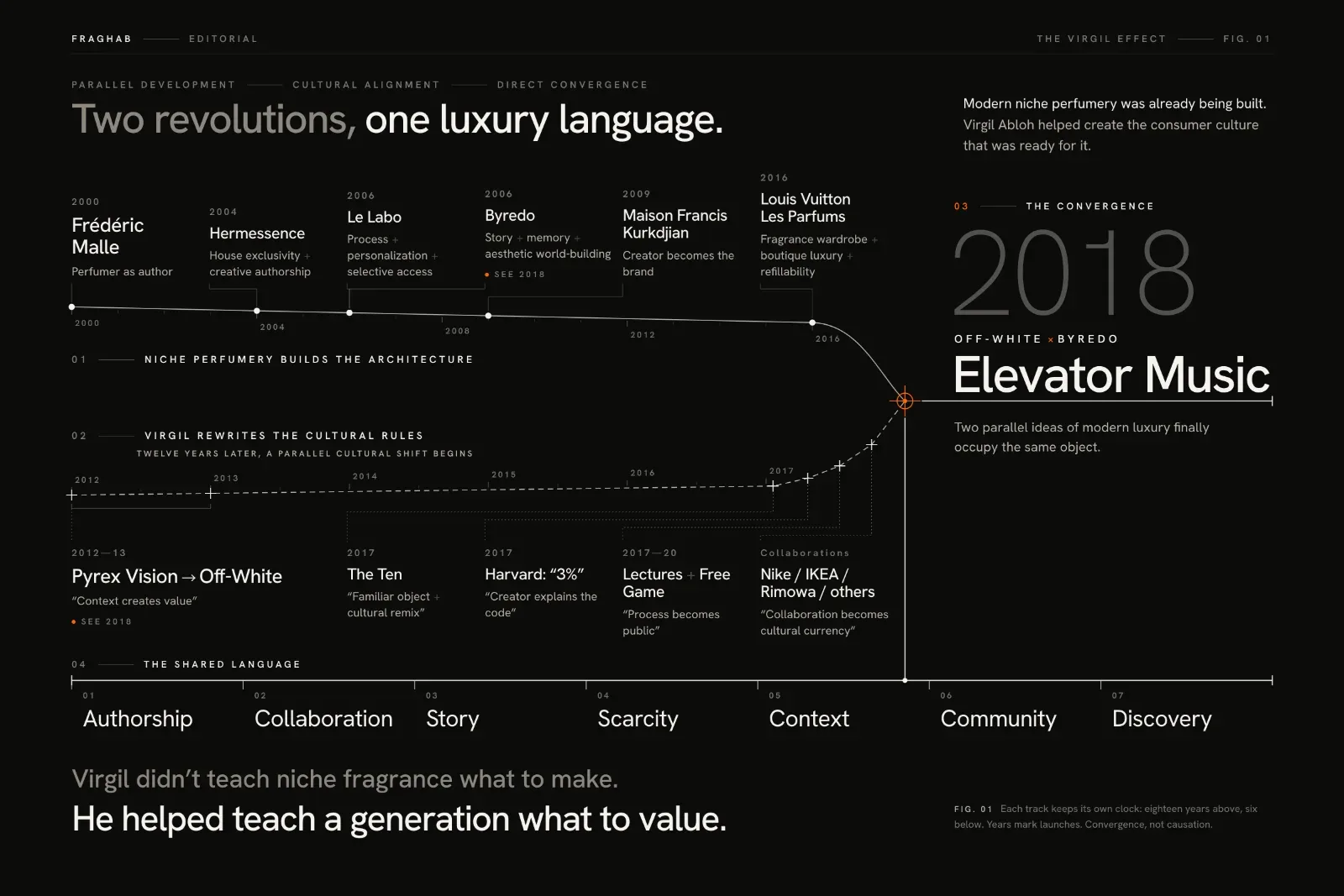
Frédéric Malle was already putting perfumers at the center of the product in 2000. Hermès introduced Hermessence in 2004. Le Labo and Byredo were founded in 2006. Maison Francis Kurkdjian followed in 2009. Louis Vuitton had already begun building its modern high-perfumery program before Virgil became Men's Artistic Director in 2018. The essential architecture of modern niche fragrance existed before Off-White became a global cultural force.
That chronology does not make Virgil less important to this story. It makes his influence more interesting.
He did not need to invent niche perfumery to help accelerate the conditions in which it could flourish. His larger contribution was cultural. Virgil became one of the most visible figures demonstrating that modern luxury no longer had to be defined exclusively by heritage, institutional authority or traditional ideas of exclusivity. Luxury could be built through cultural fluency, collaboration, authorship, context, access and community.
Once consumers learned to recognize those things as legitimate signals of value, niche fragrance was sitting in an unusually strong position because it had already built much of its identity around exactly those ideas.
The strongest version of the argument, then, is not that Virgil taught perfumers what to do. It is that he helped teach consumers what to look for.
He helped normalize a way of consuming luxury in which knowing the creator, understanding the reference, following the collaboration, recognizing the scarcity and participating in the surrounding culture all became part of the value of the object itself.
Niche fragrance did not need to become more like Virgil. Consumers were becoming more receptive to the kind of luxury niche fragrance had already been selling.
Virgil Taught a Generation to Read Luxury Differently
For most of the twentieth century, luxury operated largely from the top down. The institution held the authority. Chanel mattered because it was Chanel. Louis Vuitton did not need to explain why it belonged at the top of the hierarchy.
Designer fragrance often worked under the same logic. A fashion house launched a scent, attached a famous face, bought a major campaign, distributed it through department stores and presented the consumer with a finished fantasy. The name on the bottle generally mattered more than the name of the perfumer who created what was inside it.
By the 2000s and 2010s, that system was colliding with a very different cultural environment.
The internet gave consumers access to information once controlled by gatekeepers. Sneaker culture trained people to care about release dates, collaborators, editions, colorways and provenance. Forums, blogs and later social platforms allowed enthusiasts to become tastemakers without waiting for magazines, retailers or traditional luxury institutions to validate them. Products were increasingly surrounded by communities capable of explaining why they mattered before the brand's own advertising ever reached you.
Virgil understood this transition better than most traditional luxury executives.
His work repeatedly invited people to look closer. Quotation marks, zip ties, exposed foam, relocated labels, visible construction and altered familiar objects all asked the consumer to participate in decoding the product. Nike's The Ten was powerful not simply because Virgil redesigned familiar sneakers, but because those interventions made consumers conscious of the original object, the editing process and the creative hand behind it.
Ownership became more satisfying when you understood the reference.
The Creator Became Part of the Product
That same logic ran through the way Virgil presented himself. He did not hide the creative process behind institutional mystique.
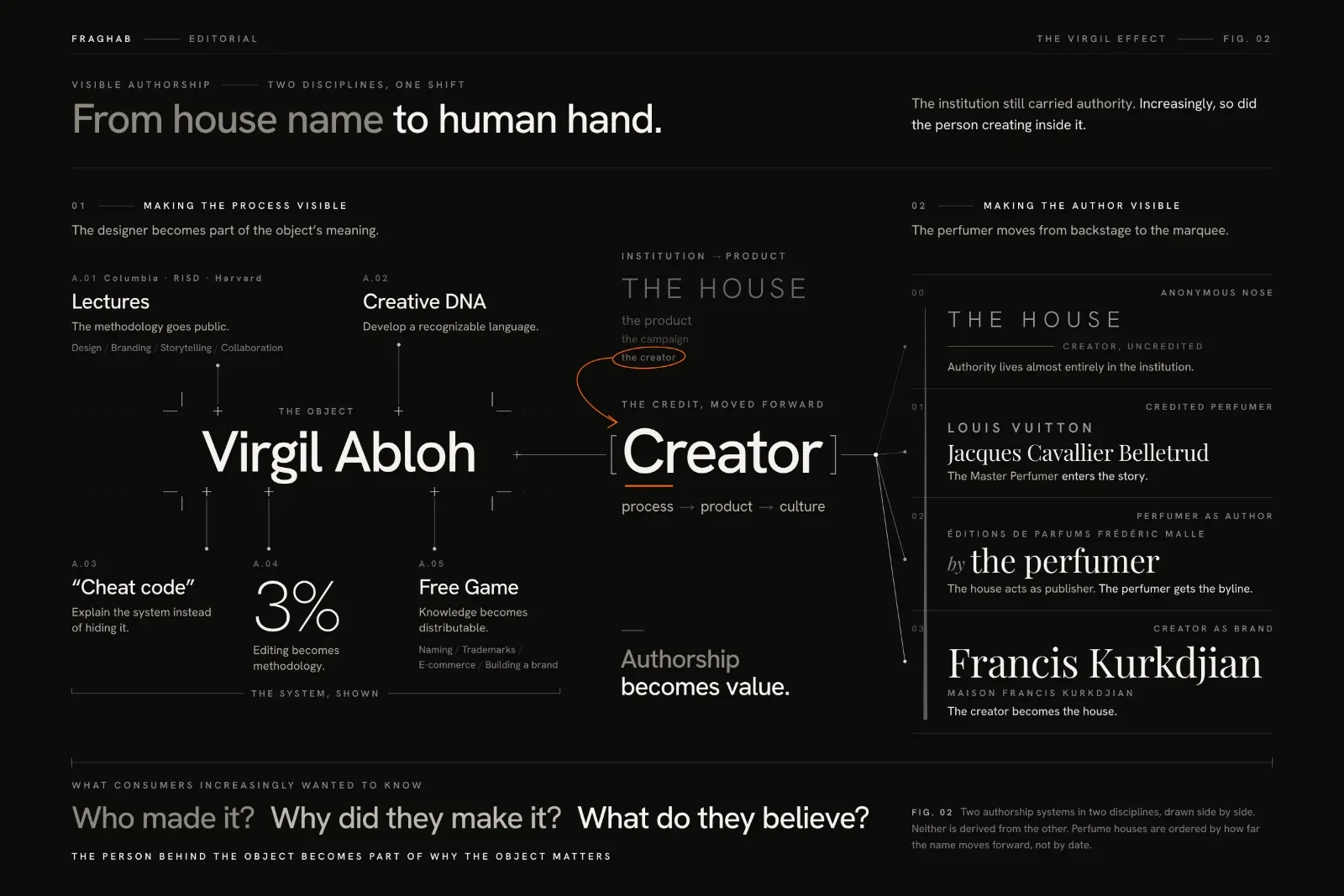
Through lectures at Columbia, RISD and Harvard, he openly discussed design, branding, storytelling, collaboration and the development of a personal creative language. At Harvard in 2017, he discussed his creative “DNA,” offered what he called a “cheat code” and articulated the approach that became widely known as his 3 percent philosophy. Later, his Free Game initiative went further, sharing practical information about naming, trademarks, e-commerce and building a brand.
That openness mattered because it made the creator increasingly important to the meaning of the product.
People did not simply want an Off-White object. They wanted to understand how Virgil thought. His name, references, methodology and personality became part of the value proposition.
His rise paralleled one of the foundational shifts in modern niche fragrance. Frédéric Malle had already elevated perfumers as authors. Maison Francis Kurkdjian literally built a brand around the name of its perfumer. Louis Vuitton would increasingly foreground Jacques Cavallier Belletrud as Master Perfumer.
Across luxury, creative authorship was becoming more visible. The person behind the object was increasingly part of why the object mattered.
The connection is not one industry copying another. It is a convergence around the same cultural truth: consumers increasingly wanted to know who made the thing, why they made it and what worldview sat behind it.
Niche Fragrance Was Perfectly Designed for the Virgil-Era Consumer
The way someone falls into niche fragrance illustrates the shift better than almost anything else.
The experience rarely stops at whether something smells good. You smell a fragrance, learn who created it, discover another perfume by the same nose, investigate the house, read about a material, order a sample set, find a discontinued release, learn about an older formulation and eventually develop opinions about ingredients you had barely heard of six months earlier.
At some point, buying perfume becomes less like purchasing a grooming product and more like entering a culture.
That behavior feels normal to fragrance enthusiasts now, but it represents a major departure from the traditional designer-fragrance model.
Niche houses built their appeal around authorship, process, rarity, discovery, selective distribution, boutique experience and cultural knowledge. Frédéric Malle treated perfumers like writers whose names deserved recognition. Le Labo made its laboratory aesthetic, labels, ingredients and retail ritual part of the experience. Byredo built an entire universe around memory, art, emotion and visual identity. Maison Francis Kurkdjian made the perfumer himself part of the brand's authority.
All of that existed before Virgil's rise.
What changed was the size of the audience fluent in this type of luxury.
A generation raised on sneakers, limited editions, creator culture, collaborations and online communities had already been trained to enjoy the hunt, the research and the feeling of knowing something before everyone else. Niche fragrance offered an entire category built around that psychology.
Virgil's influence becomes most persuasive when understood at the level of consumer behavior. He helped make cultural literacy itself feel luxurious. He reinforced the idea that the story surrounding an object could carry prestige of its own. He helped turn knowing the reference into a form of participation.
That made the emerging fragrance collector unusually legible within the broader luxury landscape.
The Most Important Virgil Lesson Was Not Scarcity
Virgil is frequently discussed through the language of drops, but reducing his influence to scarcity misses the sophistication of the model.
Off-White itself was a seasonal fashion business, and Virgil pursued extraordinary cultural reach. He worked with Nike, IKEA, Rimowa and Mercedes-Benz. He spoke at universities. He shared advice publicly. His ideas were intentionally accessible even when specific products were difficult to obtain.
That tension between broad cultural participation and selective product access may be one of the strongest connections between Virgil's work and contemporary fragrance.
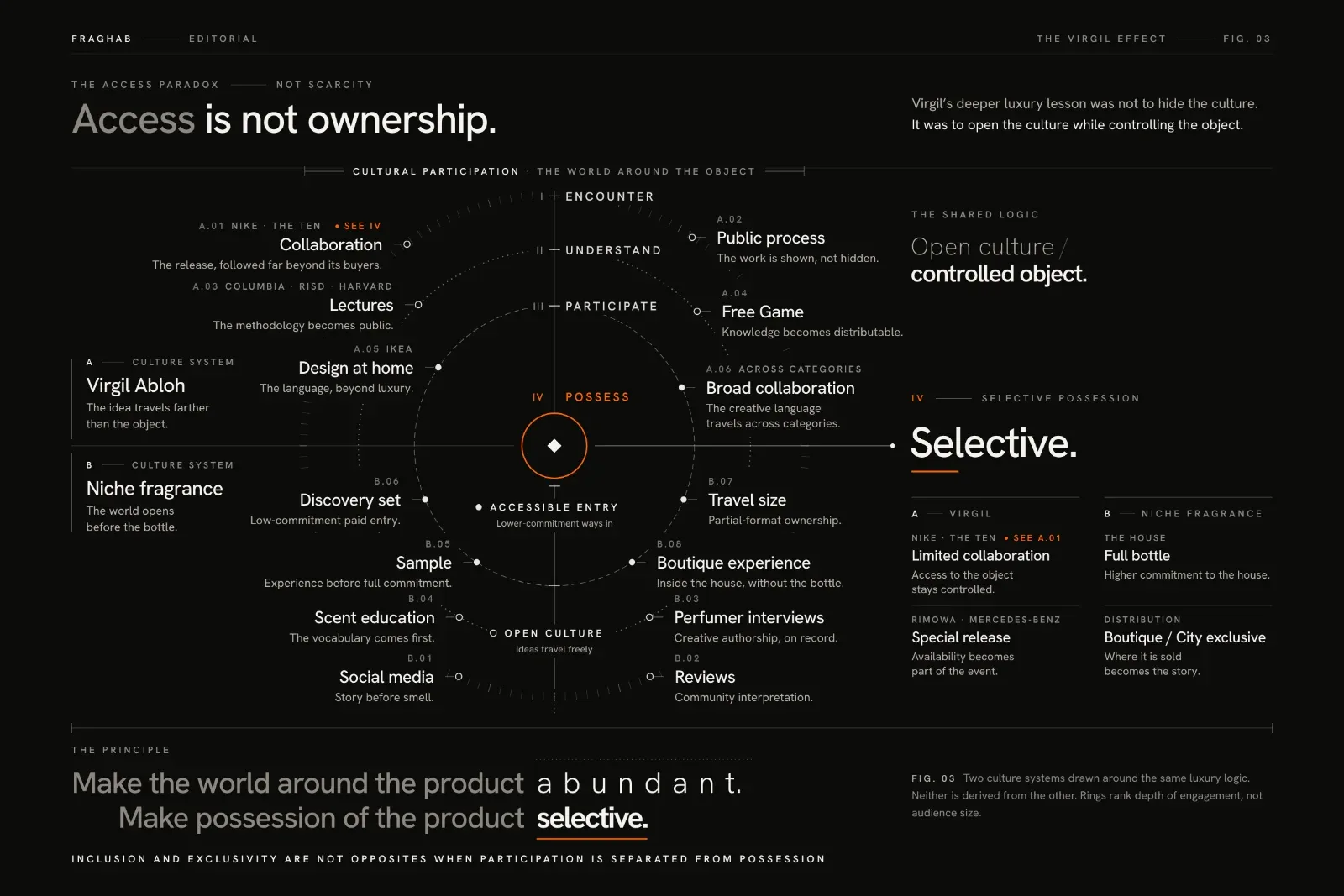
The object could remain difficult, expensive or limited while the culture surrounding it remained open to millions. You might never own a particular Off-White Nike release, but you could understand why it mattered, study the details, follow the launch and participate in the conversation.
Access to the idea was abundant even when access to the object was controlled.
Modern niche fragrance increasingly operates the same way.
A full bottle may cost $300 or more, while a discovery set provides entry into the house at a fraction of that price. A boutique sample lets someone experience the product without committing to ownership. Social platforms allow consumers to learn the history, perfumer and materials before ever smelling it. A City Exclusive or boutique-only release can make availability itself part of the story.
The deeper lesson can be stated simply:
Make the world around the product abundant. Make possession of the product feel selective.
That is a more useful way to understand Virgil's influence on modern luxury than simply calling him the architect of drop culture.
He helped demonstrate how inclusion and exclusivity could coexist. Anyone could participate in the culture, but not everyone would own the object.
Niche fragrance was perfectly suited to that balance.
Elevator Music Was the Moment the Two Worlds Touched
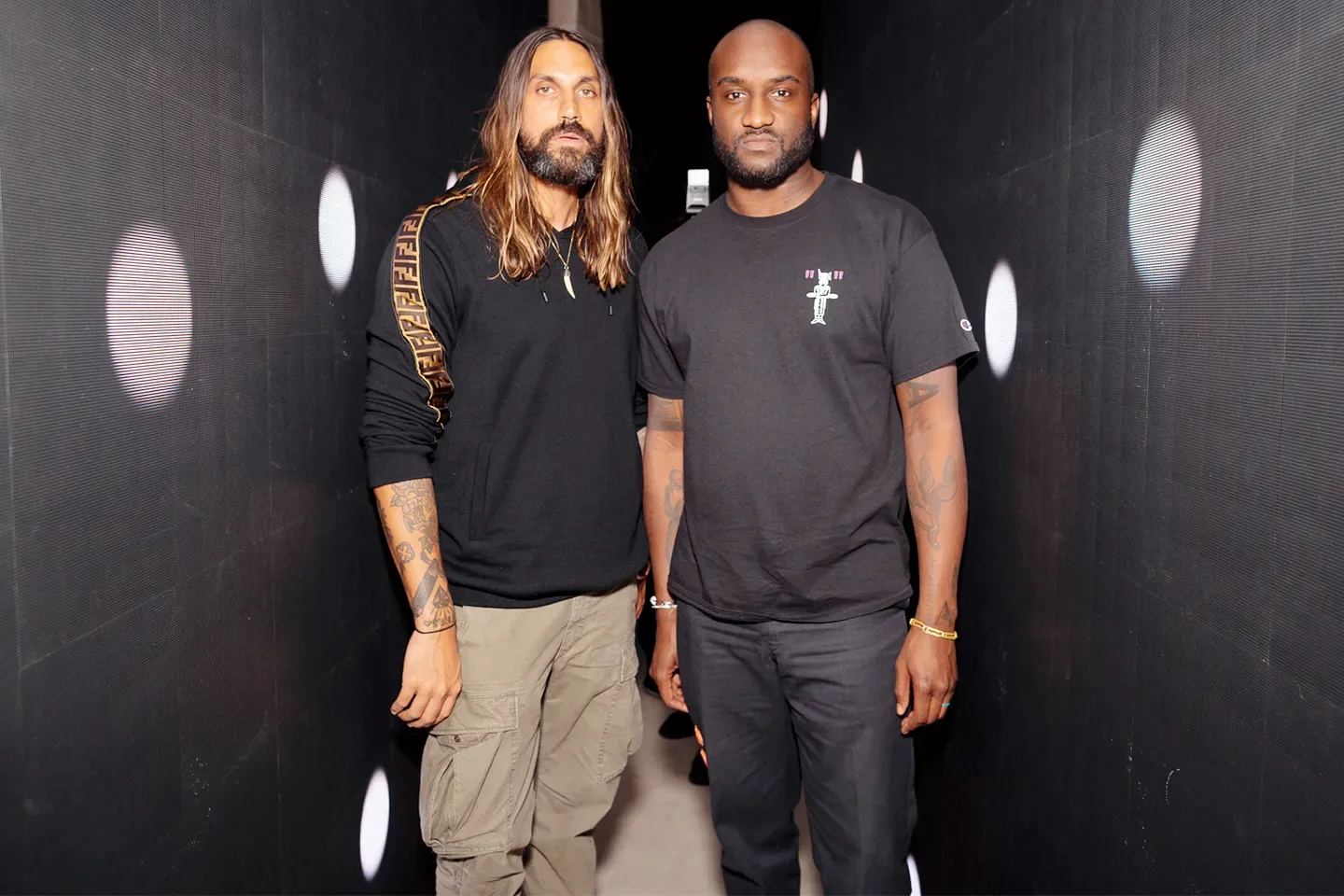
The argument becomes more than cultural analogy in 2018, when Virgil Abloh and Byredo founder Ben Gorham collaborated on Elevator Music.
This is the hinge of the story because it provides a direct connection between one of the most important figures in contemporary luxury and one of the defining modern niche fragrance houses.
Elevator Music was not treated as a conventional designer fragrance. The project extended across scent, fashion, objects and experiential presentation. Virgil described perfume as an opportunity to design something “invisible,” which is revealing in itself.
He did not treat scent as a secondary beauty category or a licensing exercise. He approached it as another creative medium capable of carrying the same ideas he was exploring through fashion, furniture, sneakers and industrial objects.
Byredo made perfect sense as the partner.
Ben Gorham had already built a fragrance house around memory, emotional narrative, art direction and cultural context. Virgil had built a career demonstrating that cultural context could turn a familiar object into a coveted luxury product.
When the two collaborated, it did not feel like one side teaching the other how to operate. It felt like two parallel systems recognizing each other.
That is what makes Elevator Music more important than a novelty collaboration.
It is the point where the relationship between Virgil-era luxury and niche perfume becomes visible rather than theoretical. Byredo had spent more than a decade proving that perfume could function like contemporary culture. Virgil had spent years proving that contemporary culture could function like luxury.
Elevator Music was the moment those two propositions occupied the same object.
Virgil's Larger Influence Was About Cultural Authority
Virgil's legacy is often summarized as the moment streetwear entered luxury, but that description is too narrow.
Hoodies on runways and sneakers inside Louis Vuitton were the visible results of a deeper change. What Virgil challenged was where luxury authority was allowed to come from.
For generations, authority flowed outward from the institution. A heritage house possessed legitimacy because history said it did.
Virgil demonstrated that authority could also arrive from culture and then move inward.
Music, architecture, skateboarding, sneaker culture, graphic design, nightlife and online communities could generate taste independently of the traditional luxury establishment. The institution could then seek access to that authority rather than assuming it already possessed it.
That shift was enormously favorable to niche perfumery.
An independent fragrance house did not need a century of couture history to become important. A perfumer could become the authority. A small boutique could become a destination. A collector community could elevate a fragrance with little dependence on traditional advertising. A twenty-year-old perfume brand could possess more cultural heat among fragrance enthusiasts than a fashion house founded generations earlier.
Virgil's significance lies in how visibly he embodied this new direction of travel.
When Louis Vuitton appointed him Men's Artistic Director in 2018, the institution did not simply absorb an outsider and erase what made him different. His cultural credibility was precisely what made him valuable.
The old establishment wanted access to authority he had developed outside it.
That pattern would become increasingly familiar across luxury.
Fashion Houses Started Learning to Behave Like Niche Houses
The fashion industry's move toward high perfumery did not happen overnight, and it did not begin with Virgil.
Hermès introduced Hermessence in 2004. Louis Vuitton relaunched fragrance in 2016 with Jacques Cavallier Belletrud, boutique distribution, refillable bottles, rare-material narratives and a seven-fragrance wardrobe.
Those examples matter because they establish the chronology clearly: designer high perfumery was already developing before Virgil's arrival at Louis Vuitton.
What changed afterward was the scale and normalization of the model.
Gucci launched The Alchemist's Garden in 2019 as an entire olfactory world of eaux de parfum, oils and scented waters built around materials and layering. Celine introduced Haute Parfumerie that same year as an eleven-fragrance concept with dedicated retail. Bottega Veneta returned to fragrance in 2024 with five fragrances, sculptural bottles, selective distribution, refillability and prices around $450. Balmain launched eight all-gender eaux de parfum. Balenciaga returned in 2025 with ten fragrances at once, using archive, couture language and the reconstruction of Le Dix as the foundation of a complete fragrance universe.
The difference between these programs and the traditional designer-fragrance model is substantial.
The older formula often sought maximum reach through one broadly appealing hero fragrance, a large advertising campaign and broad retail distribution.
The newer high-perfumery model seeks depth.
It asks the customer to enter a world, choose among multiple scents, learn the creative language of the collection, appreciate the materials and perhaps eventually acquire several bottles.
The question is no longer simply whether someone wants the Balenciaga fragrance.
It becomes which Balenciaga fragrance belongs in their wardrobe.
That is collector logic. It is wardrobe logic.
It is the logic niche perfume spent years proving could work.
Luxury Did Not Just Copy the Language. It Bought the Speakers.
The clearest evidence that niche fragrance became strategically important is not aesthetic.
It is financial.
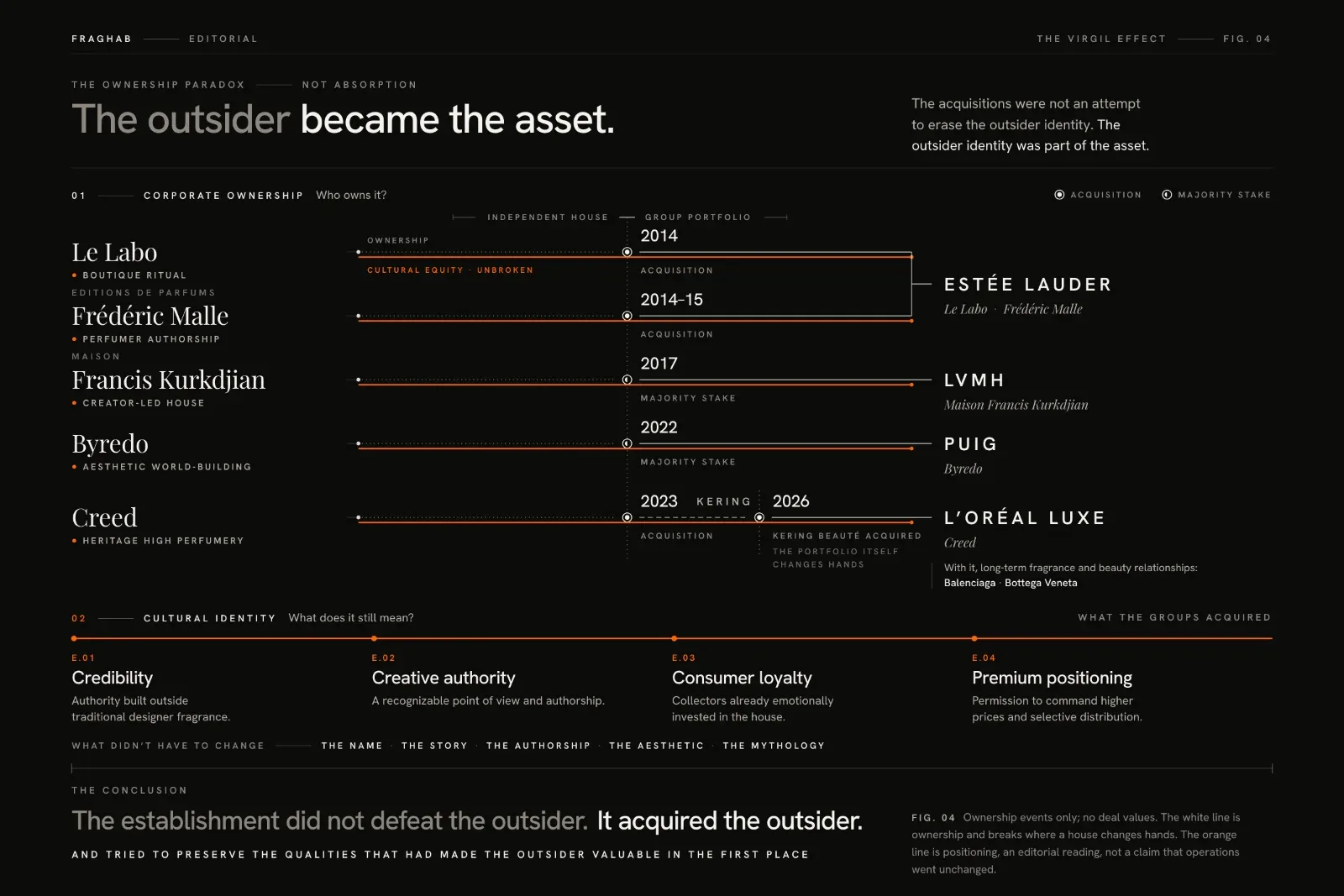
Estée Lauder acquired Le Labo in 2014 and added Editions de Parfums Frédéric Malle to its portfolio soon afterward. LVMH took a majority stake in Maison Francis Kurkdjian in 2017. Puig acquired a majority stake in Byredo in 2022. Kering acquired Creed in 2023. In March 2026, L'Oréal completed its acquisition of Kering Beauté, bringing Creed into L'Oréal Luxe while establishing long-term fragrance and beauty relationships around major fashion houses including Balenciaga and Bottega Veneta.
At that point, the distinction between “niche” and “corporate” becomes difficult to maintain.
Le Labo can still behave culturally like a niche fragrance house while belonging to Estée Lauder. Byredo can retain the aesthetic identity that made it desirable while sitting inside Puig. Maison Francis Kurkdjian can remain centered on Francis Kurkdjian's authorship while operating inside LVMH. Creed can be marketed as niche while belonging to the world's largest beauty company.
This tells us something important.
The large groups did not buy these brands because they wanted to erase what made them niche. The niche identity was part of the asset.
They wanted the credibility, creative authority, consumer loyalty and premium positioning that had been built precisely by behaving differently from traditional mass designer fragrance.
The establishment, in other words, did not simply defeat the outsider.
It acquired the outsider and tried to preserve the qualities that had made the outsider valuable in the first place.
This Is Where Virgil's Career Becomes an Important Parallel
Virgil's trajectory from Pyrex Vision and Off-White to Louis Vuitton represents the same larger institutional logic.
Cultural authority develops outside the traditional center, becomes impossible for the center to ignore and is eventually brought inside.
Louis Vuitton did not appoint Virgil because it wanted him to behave like every creative director who came before him. It wanted access to what he represented culturally.
That makes his career useful as more than a metaphor.
Virgil became one of the defining examples of luxury recognizing that it could no longer generate every form of cultural authority internally. Sometimes the most valuable thing a heritage institution could do was identify the person, brand or subculture already shaping the future and bring it into the system.
Modern fragrance consolidation follows a strikingly similar pattern.
Le Labo, Byredo, Maison Francis Kurkdjian, Frédéric Malle and Creed accumulated authority through differentiated identities. Once that authority became commercially undeniable, large groups wanted ownership.
Virgil did not cause those acquisitions.
His significance is that his career made this movement from outsider culture into institutional luxury one of the defining stories of the era.
The Market Eventually Validated the Shift
The commercial growth of fragrance helps explain why fashion houses and beauty groups have intensified their attention.
U.S. prestige fragrance grew 12 percent in 2024, making it the fastest-growing category within prestige beauty. Through September 2025, prestige fragrance reached $5.9 billion, while mini and discovery sets grew 41 percent. In the first half of 2026, prestige fragrance continued to grow, luxury fragrance increased 15 percent and higher concentrations continued to perform strongly. Circana has also pointed to social platforms as an increasingly important route between fragrance discovery and purchase.
That final point may be the most revealing.
The department-store counter is no longer the only place where fragrance authority is created.
A collector on TikTok can introduce thousands of people to a perfume they have never smelled. Reddit communities can elevate forgotten scents. YouTube reviewers can generate interest in a niche release before many consumers ever encounter it in person.
Discovery increasingly happens through networks of enthusiasts rather than exclusively through traditional luxury marketing.
This is exactly the kind of cultural environment Virgil understood.
Authority is distributed. Consumers become participants. Knowledge travels laterally through communities. The person explaining why an object matters may have no official relationship with the company selling it.
Luxury behaves very differently in that environment than it does in one built solely around controlled institutional messaging.
Virgil Helped Create the Consumer Niche Fragrance Needed
This is ultimately where the argument should land.
Virgil did not teach Frédéric Malle to treat perfumers like authors. He did not teach Le Labo selective distribution. He did not teach Ben Gorham how to build a fragrance around memory or story.
Those innovations already belonged to perfume.
What Virgil helped do was make the broader culture increasingly receptive to those ideas.
He helped normalize a model of luxury built around authorship, collaboration, cultural fluency, process, collectibility, selective access and community. He made the creator part of the mythology. He showed that consumers could be invited behind the curtain without destroying desire. He demonstrated that an enormous cultural audience could coexist with scarce products. He helped make understanding the object part of the pleasure of owning it.
Niche fragrance already spoke that language.
Virgil helped make more people fluent in it.
That distinction gives him a larger role in this story than simply claiming perfume houses copied Off-White.
Direct imitation would actually be the smaller form of influence.
Changing the cultural environment in which an entire category becomes legible is larger.
Everyone Speaks the Language Now
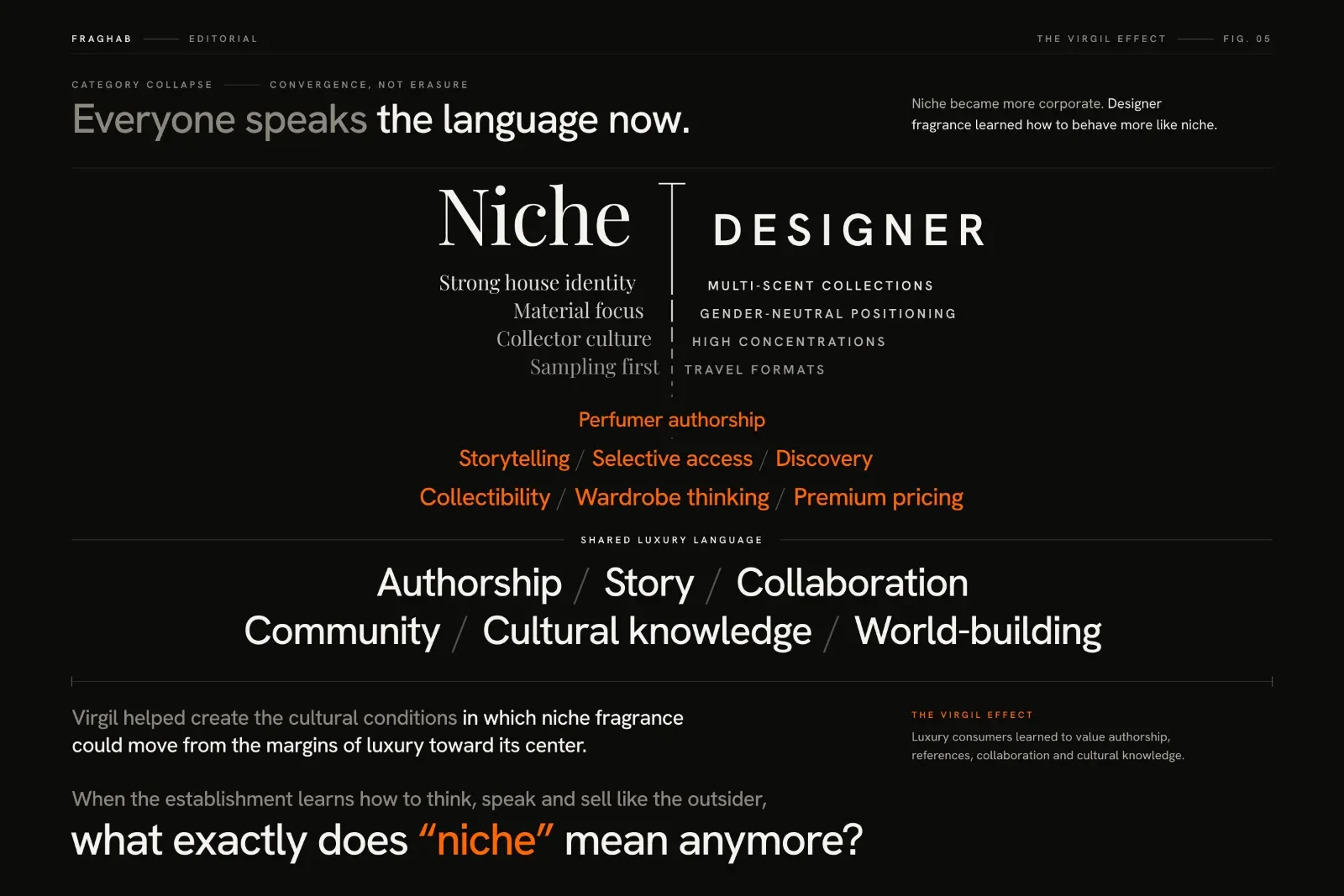
Walk through the upper end of fragrance in 2026 and the distinction between niche and designer has become increasingly difficult to define.
A fashion house can launch ten all-gender fragrances at once. A niche house can belong to one of the world's largest corporations. A designer perfume can cost more than many independent niche releases. Perfumers are increasingly treated as creative authors. Discovery sets have become strategically important. Consumers build fragrance wardrobes rather than searching for one lifelong signature scent.
The niche house has become more corporate while the corporate house has learned how to look more niche.
That is why Virgil belongs in this story.
Not because he secretly invented the perfume industry's tactics, but because he helped redefine the larger luxury culture in which those tactics became extraordinarily powerful.
His generation of luxury taught consumers to care about who made something, what it referenced, how it was released, who collaborated on it, who else understood it and what owning it said about their cultural knowledge.
Perfume happened to be almost perfectly designed for that world.
Fragrance already had authors, stories, materials, hidden references, obsessive communities, selective access and an enormous amount of meaning that existed beyond the physical liquid in the bottle.
Once a generation learned to consume luxury through those signals, niche fragrance had everything it needed to move closer to the cultural center.
Virgil Abloh did not create niche perfume. Giving him that credit would erase the people who built the category before him.
But minimizing his role because he did not invent those mechanics misunderstands how cultural influence works.
Virgil helped create the cultural conditions in which niche fragrance could move from the margins of luxury toward its center.
The fashion establishment eventually recognized the same shift. It learned the language, hired the talent, adopted the structures, acquired the houses and began rebuilding its own fragrance collections around many of the same principles.
Which leaves modern fragrance with a question Virgil probably would have appreciated:
When the establishment finally learns how to think, speak and sell like the outsider, what exactly does “niche” mean anymore?
Filed under
Published under Fraghab’s editorial standards. alex keeps the copyright, and wrote every word of this — an editor here cannot change them. Something wrong? Tell us.