

The Fragrance Influencer’s Bargain
Fragrance influencers brought new people into the hobby. Free bottles, affiliate links and TikTok Shop are making their recommendations harder to trust.
There’s a particular kind of fragrance video I can almost recite with the sound off. The package looks expensive. There’s a handwritten card inside, maybe a little tissue paper for the unboxing. The creator holds the bottle up to the light, sprays a wrist and takes a moment to look impressed. Then come the promises: incredible performance, compliments all day, niche quality without the niche price. If you hurry, there’s a code in the caption.
Sometimes they tell you the bottle was sent to them. Sometimes you have to work that out for yourself.
I watch fragrance content. I’ve bought fragrances because of it. I’ve also spent enough money on bottles that didn’t work out to pay a lot more attention to who’s making the recommendation and what they stand to gain from it.
Fragrance is a strange thing to review online. Watch collectors can show you the machining. Somebody reviewing a speaker can at least play you a recording, however badly your phone reproduces it. A fragrance reviewer has no equivalent. I can watch somebody react to a perfume for ten minutes and still have no idea what it will smell like on my skin three hours later.
That makes a good reviewer genuinely useful. It also makes a bad one especially expensive to believe.
The good: creators got people interested
Fragrance discovery used to depend heavily on where you could shop. A department store counter, a sales associate with a handful of paper strips, whatever happened to be available in your area. Those places still matter, especially when you actually want to smell something, but they don’t control the conversation anymore.
Creators helped make fragrance collecting feel accessible. You could learn the differences between an amber and a fougère, hear someone describe how an expensive perfume changed over a full day, or find out that there were interesting houses beyond the usual designer shelves. Sometimes the person explaining it knew a hell of a lot more than the person working the counter.
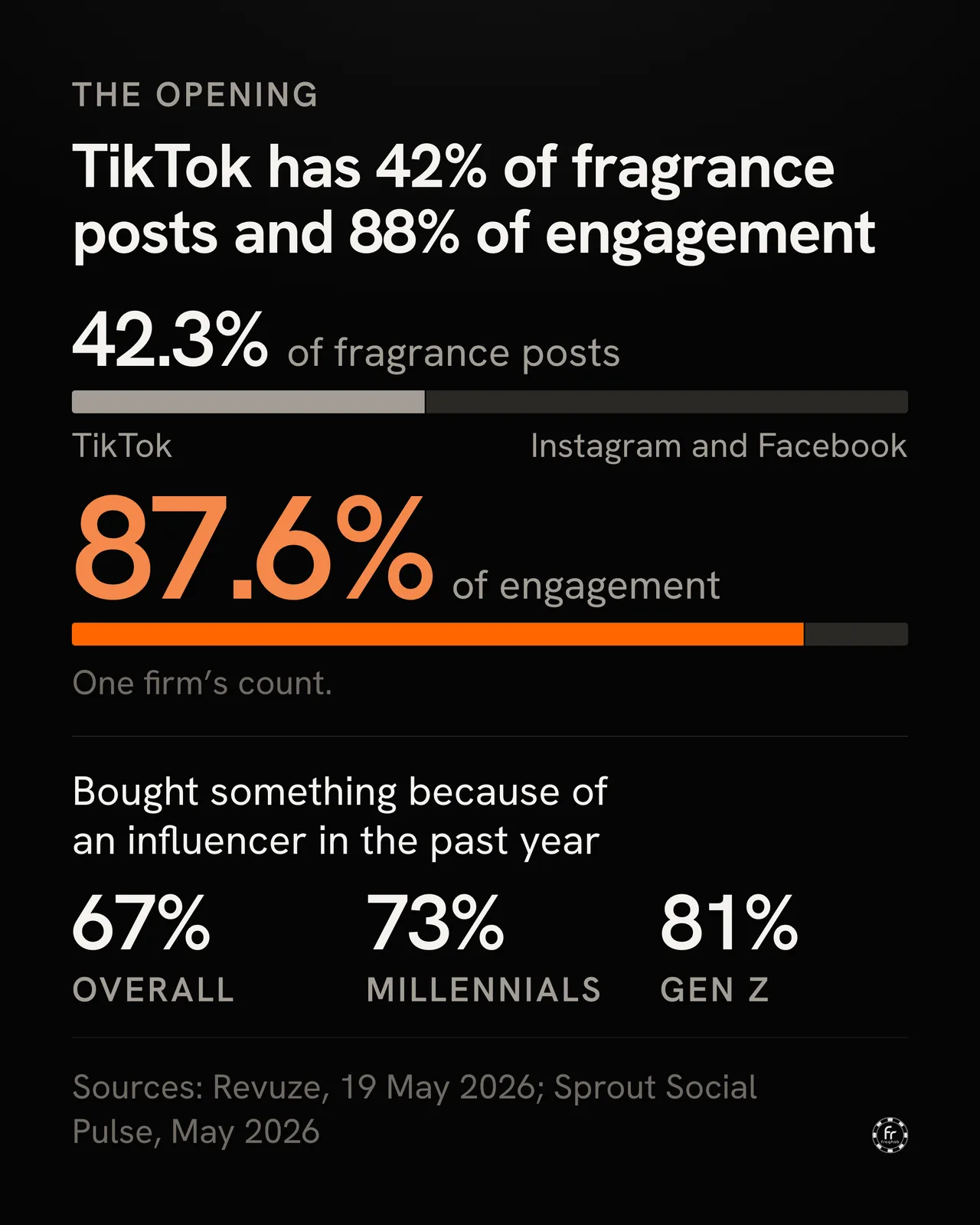
That reach has commercial consequences. In Sprout Social’s May 2026 survey, 67% of social media users in the US, UK and Australia said they had bought something because of an influencer recommendation in the preceding year. The figure was 81% among Gen Z respondents. YipitData’s 2025 estimates suggest that roughly two-thirds of US fragrance buyers purchased at least three fragrances in a year, compared with about one-third two years earlier. Creators can’t take all the credit for that shift, but they clearly helped make the idea of owning several different fragrances feel normal.
What’s happened with creator-led products this year is more interesting than another round of sponsored reviews. Some creators are getting involved in the fragrance itself, and their audiences are willing to put money behind them.
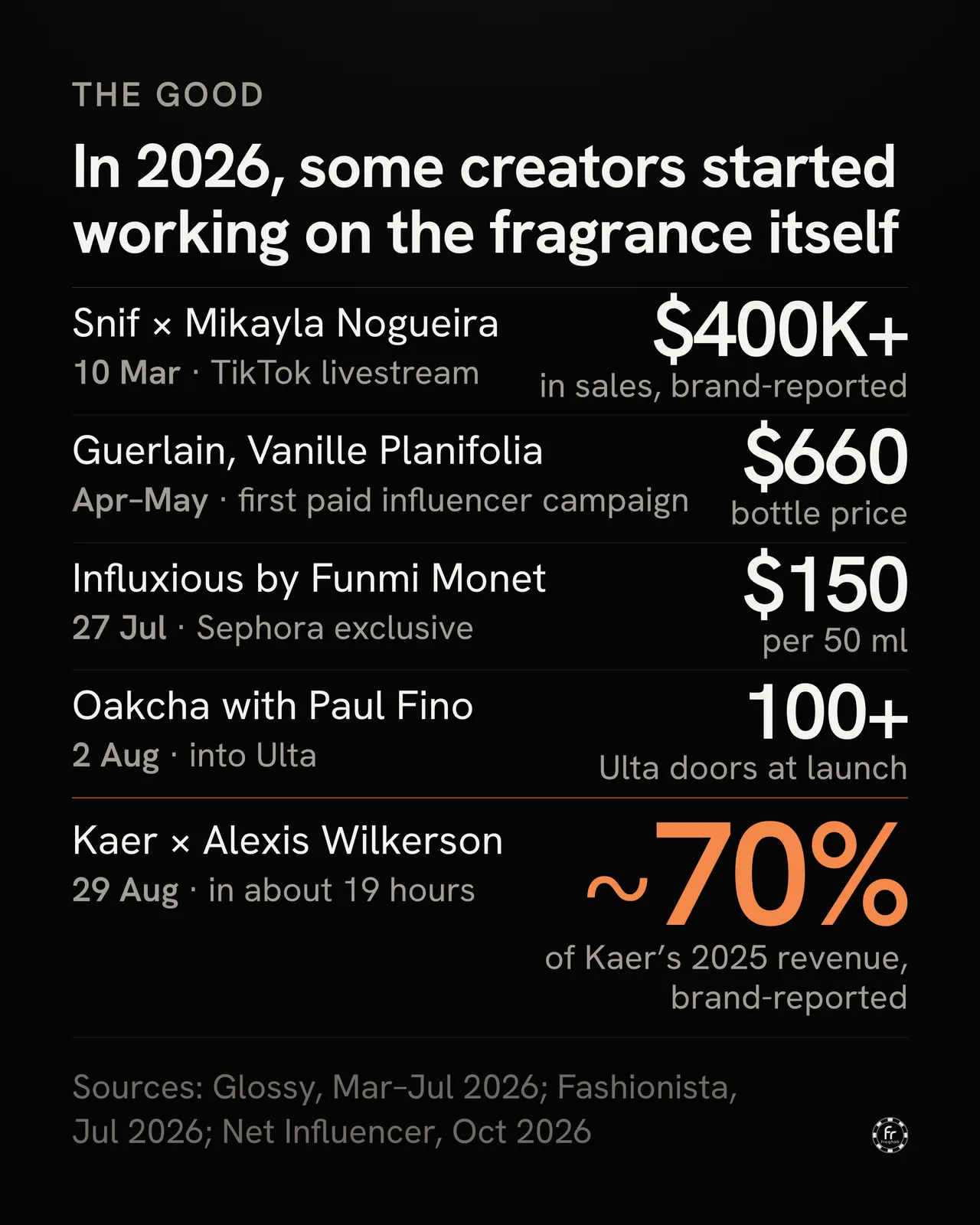
Snif says its Only Sunshine collaboration with Mikayla Nogueira generated more than $400,000 in a four-hour TikTok livestream on March 10, watched by more than a million people. Kaer says an oil co-designed with Alexis Wilkerson brought in about $96,000 in roughly 19 hours, equivalent to around 70% of Kaer’s entire revenue in 2025. The brand also says more than 80% of buyers were new customers. Those are company-reported results, but they’re substantial for a launch built around a creator’s audience.
Funmi Monet took a different route, introducing Influxious as a Sephora exclusive on July 27, priced at $150 for 50 ml. Oakcha’s partnership with Paul Fino reached more than 100 Ulta locations on August 2, with a plan to expand to 700 by October. These aren’t identical deals, but they show how far the relationship between fragrance brands and creators has moved beyond a free bottle and a promo code.
Even Guerlain has adjusted. This spring it ran what was reported as its first paid fragrance influencer campaign, promoting the $660 Vanille Planifolia after creators including Paul Fino and Aysha Harun had already talked about it without prompting. The fragrance had sold out on Guerlain’s website before the brand began paying for that kind of attention.
There are people in this space whose judgment I value. CG Scents is one of them. He says on his channel that he doesn’t accept free products or affiliate links, and his reviews often come after a week of wearing something. He’s also perfectly comfortable saying that an expensive bottle isn’t worth the money. I don’t have to agree with every take to appreciate that approach. It gives me something more useful than another first impression.
The bad: more content, less to say
After a while, fragrance content starts to sound like one continuous review. Every other release is supposedly a masterpiece. Everything projects like crazy. Everything costs a fraction of what it smells like. And an alarming number of fragrances are apparently guaranteed to attract strangers from across the room.
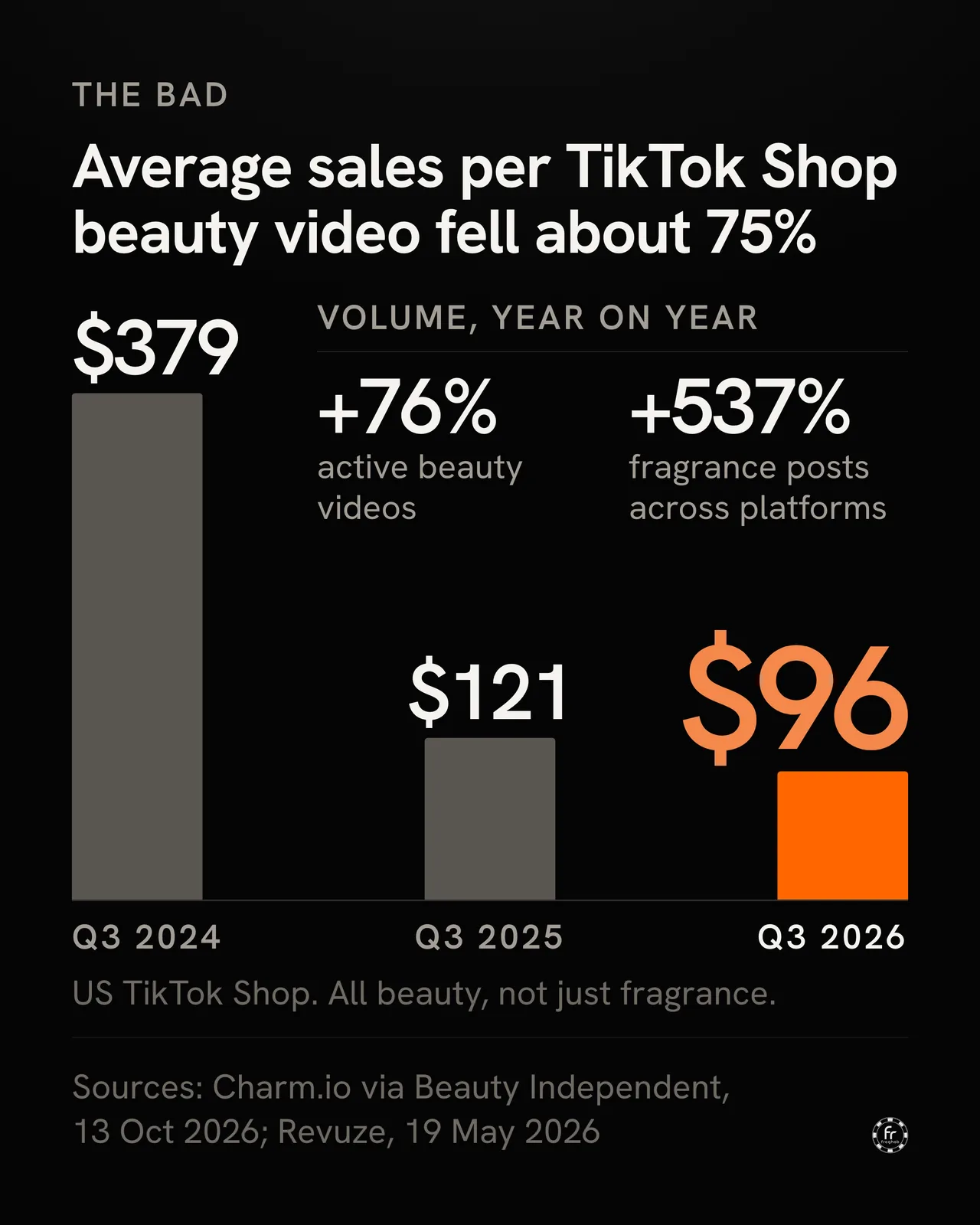
The volume helps explain the repetition. Revuze estimates that fragrance posting across the platforms it studied rose 537% year over year. Meanwhile, Charm.io’s TikTok Shop data shows average US beauty sales per active video falling from about $379 in the third quarter of 2024 to about $96 in the third quarter of 2026, even as the number of active videos increased 76% in the latest year. That figure covers beauty as a whole, not just fragrance, and it measures sales per video rather than total demand. Still, it’s a fairly clear picture of more people making videos and each video doing less commercial work.
Brands have responded by sending out more product. Snif has said it puts thousands of samples into creators’ hands each month. Beauty founders interviewed by Beauty Independent described the diminishing returns of mass gifting. It isn’t hard to see why. A bottle arriving in a PR package is no longer an event when half your feed has the same package.
The more troubling result is what gets rewarded. Revuze’s analysis suggests posts about feelings and experiences generate more engagement than posts focused on the scent itself. Think about how many reviews spend most of their time telling you what sort of person you’ll appear to be wearing the fragrance. Rich. Seductive. Confident. The most interesting thing about the perfume, which is how it actually smells and develops, gets squeezed into a few broad adjectives.
That might make for entertaining videos. It’s pretty thin buying advice, especially when someone is recommending a $200 or $300 bottle to an audience that may never have sampled it.
I’ve learned that lesson myself. Cal Cologne talked about a fragrance with a tomato-leaf note that he wasn’t really picking up. He said if it did show through, it might be funky. I bought it without testing. Two or three hours into wearing it, there was the tomato leaf, and yes, it was funky. It was enough to make the purchase a miss for me.
I don’t think that means Cal lied or reviewed it badly. His nose and my skin gave us different experiences. That’s exactly the problem with buying something unsmelled on another person’s recommendation. A perfectly sincere review can still lead you straight into a bottle you don’t want to wear.
There are signs that buyers know this. Sprout found that 57% of respondents trusted everyday users for product recommendations, versus 9% who trusted mega-influencers. In a separate Statista survey of US beauty shoppers, 56% cited price among their top three purchase influences, while only 10% chose influencers. Those studies measure different things, but together they suggest that visibility and credibility aren’t the same thing.
I still get recommendations from creators. I’m much more cautious about letting a recommendation substitute for a sample.
The ugly: follow the free bottles
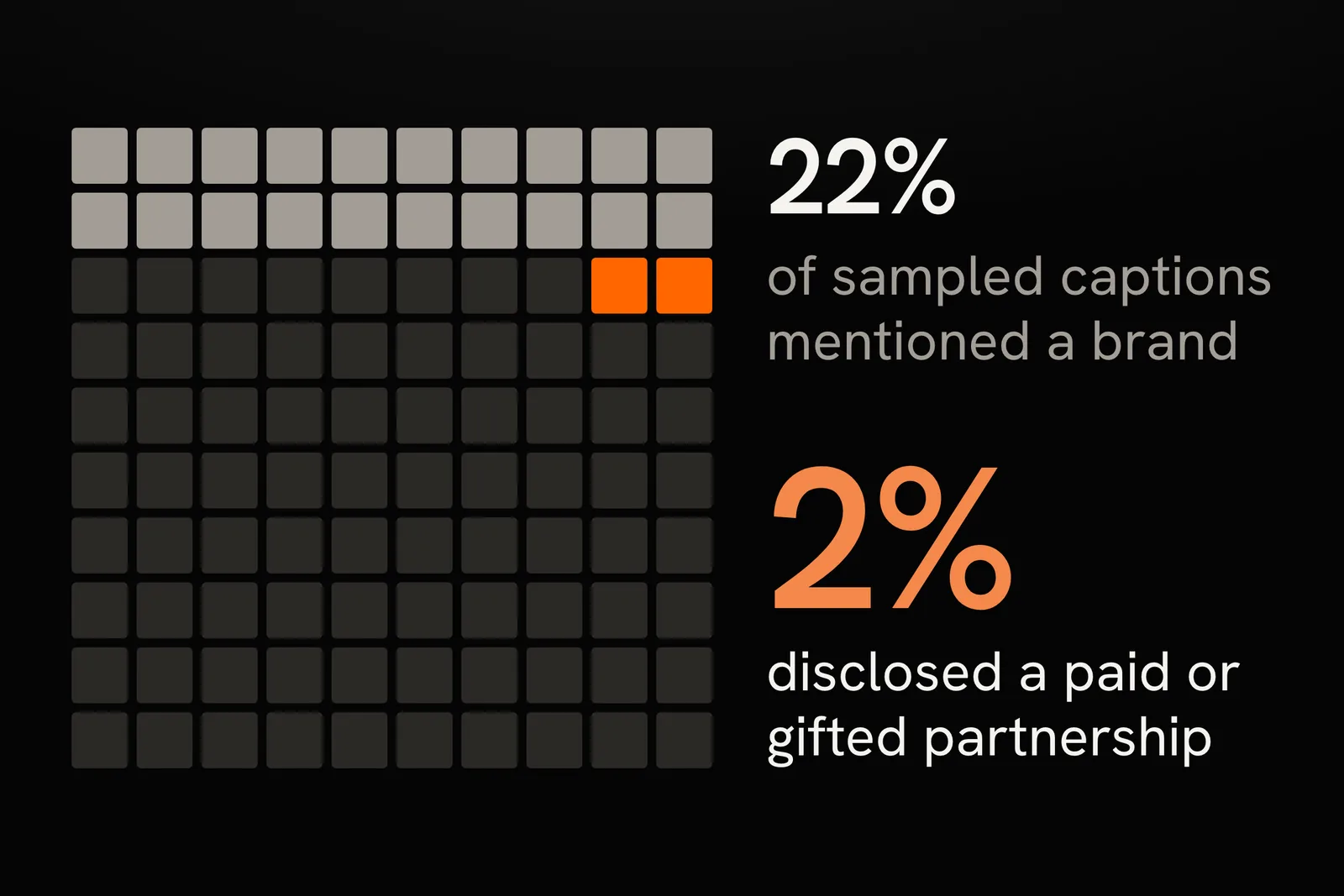
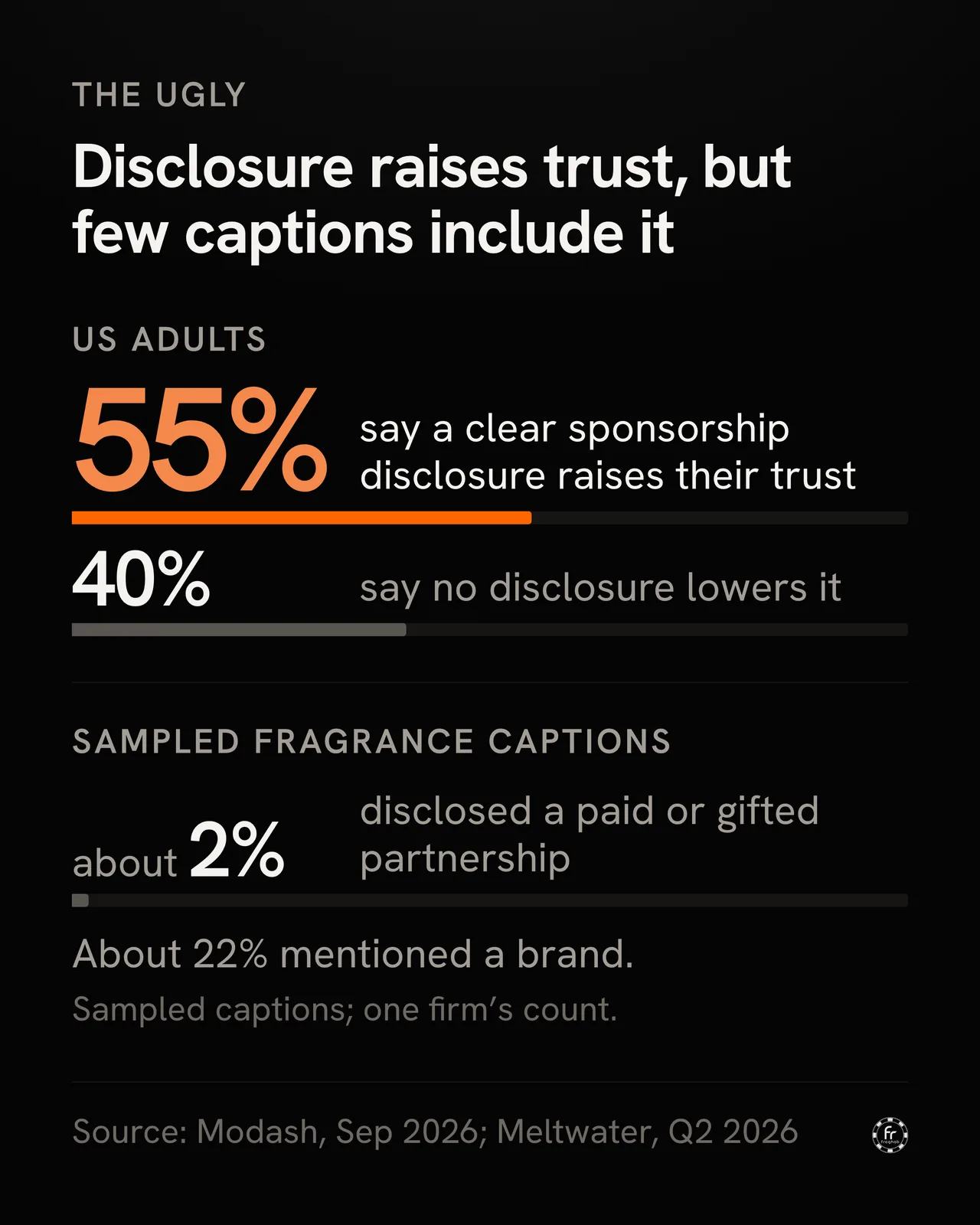
One of the most uncomfortable numbers in the research came from Meltwater. The company examined 5,812 posts from 1,000 macro fragrance creators during the second quarter of 2026. In the captions it sampled, about 22% mentioned a brand. Only about 2% disclosed a paid or gifted relationship.
That is one company’s analysis and it hasn’t been independently replicated. More importantly, it does not establish that every other post involved an undisclosed sponsorship. Many posts may have been entirely organic. Others may have used a platform’s paid-partnership label instead of putting the disclosure in the caption, a limitation Meltwater itself acknowledges. We don’t know how many of the posts actually required a disclosure, and that distinction matters.
What the analysis does show is how rarely a commercial relationship was identified in the captions Meltwater reviewed. In a category where brands routinely seed products to creators, I think that deserves scrutiny.
A free bottle can be a material connection. So can a commission, a paid partnership or a discount code that rewards the person sharing it. The US Federal Trade Commission expects endorsers to disclose relationships that could affect the weight consumers give an endorsement, and brands can face liability for misleading endorsements. UK regulators have also pressed for unmistakable advertising labels rather than vague language such as “gifted” or “collab” where an endorsement counts as advertising.
Australia offered a very concrete example in March. Its competition regulator fined PhotobookShop A$39,600 after the company instructed influencers on 107 occasions not to disclose gifted products. In the US, free merchandise connected with promotional work can also create taxable income. Calling something PR doesn’t make the commercial arrangement disappear.
What makes the secrecy especially strange is that audiences appear to prefer transparency. In Modash’s September 2026 survey, 55% of US adults said a clear sponsorship disclosure made them trust a creator more, while 40% said a missing disclosure damaged their trust.
The claims creators make are getting examined in court, too. Sol de Janeiro’s amended complaint against MCoBeauty cites influencer videos describing products as smelling “exactly” like its Cheirosa scents and lasting “all day.” MCoBeauty moved to dismiss the case in January, arguing in part that statements like those amount to puffery, the sort of promotional exaggeration a reasonable consumer should not treat as a literal promise. As of October 2026, the motion was still pending.
I understand the legal distinction between an opinion and an objectively testable advertising claim. What bothers me is how easily the same sales language can be persuasive enough to move bottles and, when challenged, be dismissed as something consumers shouldn’t have believed in the first place.
Livestream shopping adds another problem. TikTok’s beauty team has said that 76% of its fragrance users have purchased through a livestream. That’s an impressive channel for conversion, but there is virtually no opportunity to assess authenticity or smell before buying. In May, Vietnamese police reported breaking up a counterfeit-perfume operation accused of selling around 100,000 bottles through social accounts and livestreams, generating more than $7.6 million. TikTok also introduced a seller-verification program called TikTok Real in May, initially covering around 100 brands. It’s worthwhile, but hardly covers the entire market.
The most absurd episode involved a creator who couldn’t smell anything at all. Slate Brands introduced Iris Lane, an openly AI-generated “fragrance storyteller,” in July 2025. Fragrance TikTok hated it. People questioned how a synthetic personality could recommend perfume through personal experience, and creators of color also raised concerns about work being given to an invented digital personality. The account disappeared within days.
That reaction makes sense to me. The EU’s AI Act now imposes transparency rules for certain AI-generated and manipulated content, with obligations taking effect on August 2, 2026, subject to specific exceptions and transitional provisions. Gartner reported in September that 35% of US consumers were relying less on influencers because of AI content.
It’s easy to spot the problem when an influencer is literally artificial. I’m more interested in the human accounts that offer the same thing: a confident recommendation with very little indication of what the person actually experienced or why they’re recommending it.
So who deserves the blame?
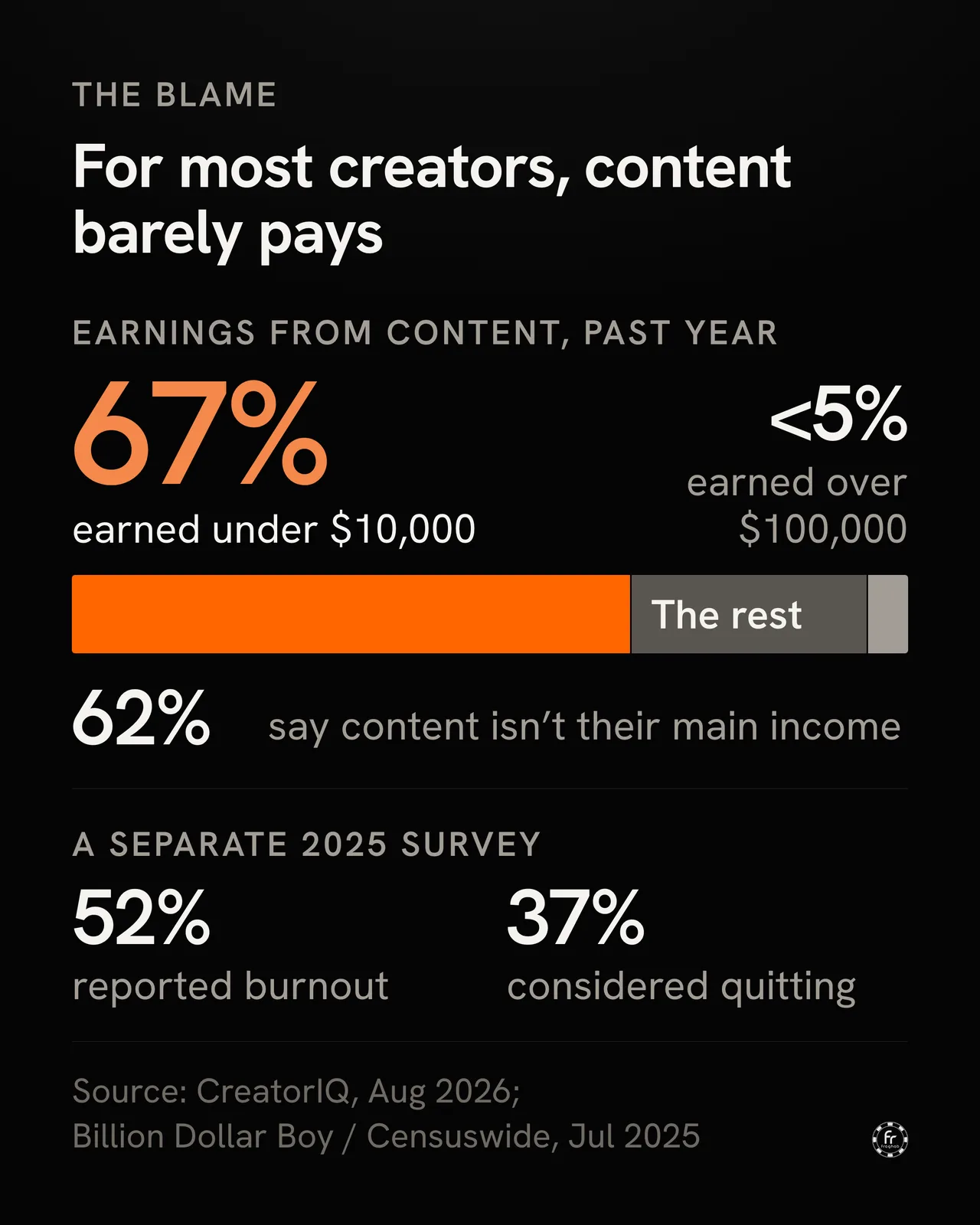
I don’t buy the argument that every creator with a discount code is a sellout. For a lot of people, content creation barely pays. CreatorIQ surveyed 5,095 creators this summer and found that 67% had earned less than $10,000 from content in the previous year. For 62%, it wasn’t their primary income. A separate 2025 survey from Billion Dollar Boy found that 52% of creators had experienced burnout and 37% had considered quitting.
Look at the economics from the other side of the camera. Smaller creators may be buying their own fragrances and hoping the videos eventually pay for themselves. Larger creators can be offered product instead of a meaningful fee. Once a brand starts sending bottles, there’s an obvious incentive to maintain the relationship. You don’t need a written instruction to be positive for that pressure to exist.
And brands are hardly passive participants. They choose who gets product, write campaign briefs, negotiate commissions, track conversions and decide who will get a second package. The creator is the face viewers recognize, but the brand often has much greater control over the commercial arrangement. Platforms contribute their own pressures by rewarding whatever stops the scroll and drives transactions. TikTok’s US restructuring and changes to its commerce systems have given sellers another set of moving targets to manage.
I also think audiences deserve a little of the blame. We keep watching unboxings, rewarding extravagant claims and asking whether we can blind buy something before the perfume has even been widely sampled. Plenty of the incentives people complain about are the ones their own viewing habits create.
None of that makes dishonesty acceptable. It’s perfectly reasonable to get excited about a free bottle. Just tell people you got it for free. It’s fine to change your opinion after wearing something for a week. Tell people that, too. And if you call a fragrance a perfect substitute for another, you should be willing to explain what you actually compared and how you tested it.
I can sympathize with someone trying to make a living without pretending viewers owe them unquestioning trust. Those two things can coexist.
I’d rather see what you actually wear
The business of recommending products online is facing more scrutiny. The FTC’s Consumer Review Rule has been in force since October 2024, covering conduct such as fake reviews, undisclosed insider testimonials and misuse of fake social influence. The agency has warned businesses about potential violations, and civil penalties can reach tens of thousands of dollars per violation. In Britain, the CMA now has the power to impose substantial fines directly on companies for certain consumer-law breaches. The EU is also working on its proposed Digital Fairness Act, with misleading influencer marketing among the concerns.
I wouldn’t pretend that new rules alone will clean up fragrance content. They won’t. But brands and creators have fewer excuses to treat disclosure as an optional courtesy.
At the same time, more affiliate relationships are becoming visible by design. Meta introduced affiliate-link tools for Reels in March, YouTube expanded its Shopping affiliate program to creators with 500 subscribers, and Sephora’s storefront initiative offers a reported 15% commission. Those arrangements still reward sales, of course. At least a clearly labelled link makes the financial interest easier to understand. On October 15, Coty announced a Fragrance Club bringing together creators, educators and perfume-industry professionals, another sign that brands want an ongoing relationship with the people shaping fragrance discussion.
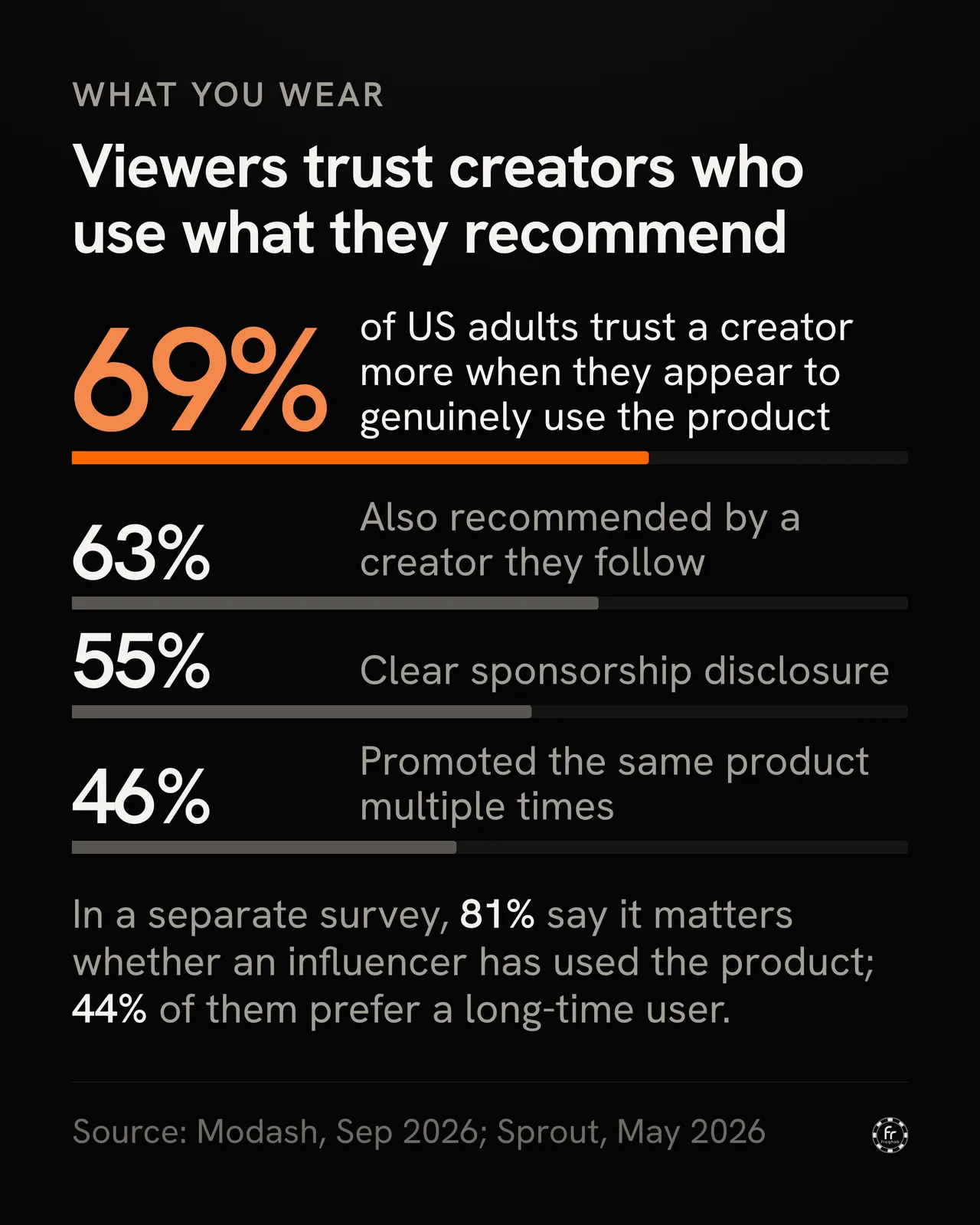
But I think the stronger pressure will come from viewers. Sprout Social found that 81% of respondents cared whether an influencer had actually used the product, and among those respondents 44% preferred a longtime user. Modash found that apparent genuine use was the biggest trust-builder it measured, cited by 69% of US adults.
That’s the kind of evidence I want more of. Tell me you’ve owned something for eight months and still reach for it. Show me what happened after the excitement of release week wore off. If it was your favorite fragrance in March and you’re selling it by June, that’s worth talking about. I’d get more value from hearing why than from another video about how luxurious the packaging feels.
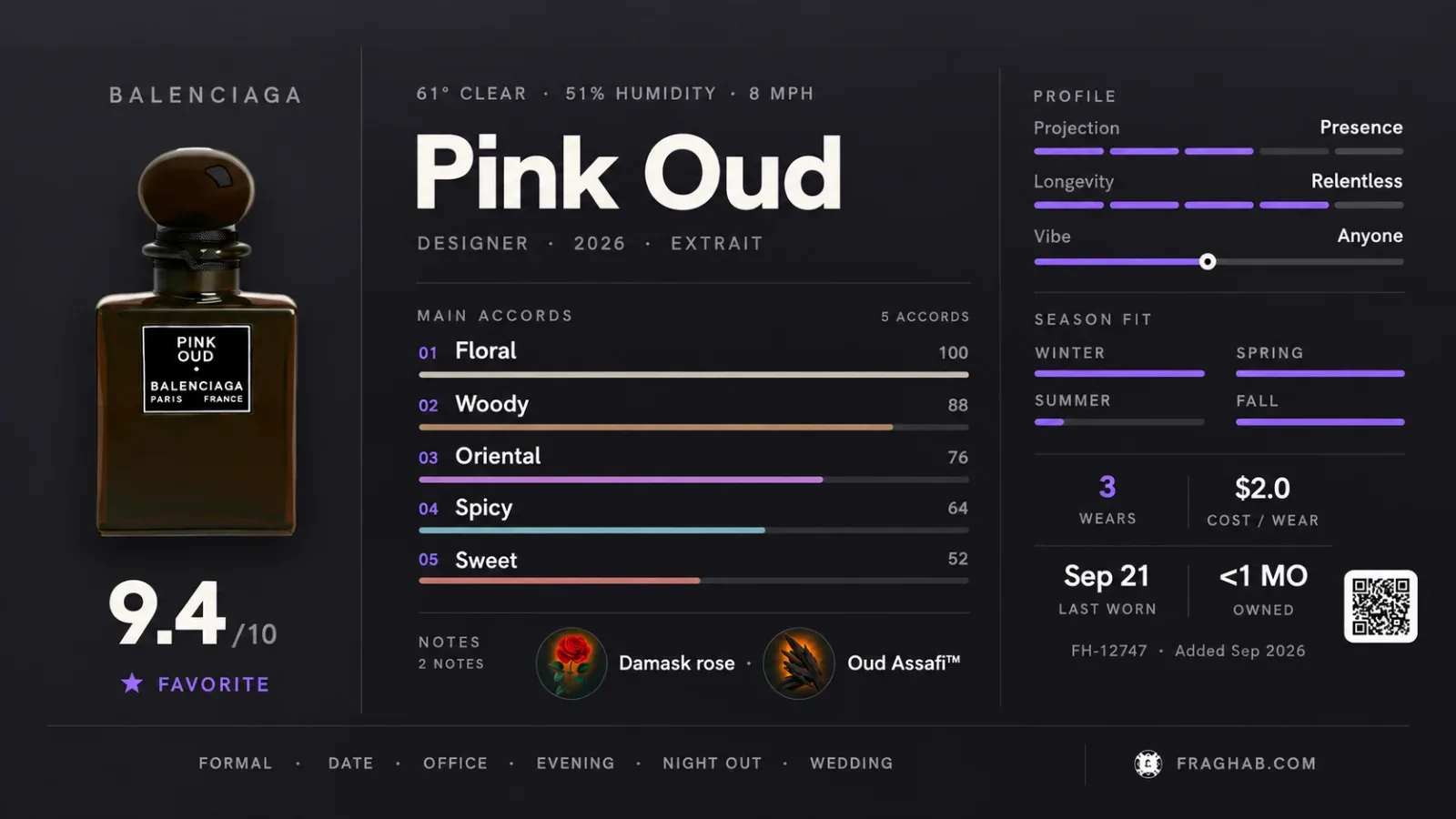
This is also why I care about keeping a record of the fragrances people own and actually wear. As the person behind Fraghab, I have an obvious interest in that idea, and I should be clear about it. A wear history can’t prove somebody’s opinion is right, and owning a bottle doesn’t make anyone an expert. But a record of repeated use gives the audience something to judge beyond a recommendation filmed on the day a box arrived. I think that’s useful.
For clarity about my own position: I’ve never accepted a free fragrance and have turned down offers. I’ve done unpaid work for a few creators whose content I believe in. Neither I nor Fraghab currently has an influencer or advertising relationship. I stand behind those statements, just as I expect anyone else making a disclosure to stand behind theirs.
I don’t want creators to stop being excited about fragrance. That excitement is a huge part of why the community is fun in the first place. I want the excitement to come with some context, and I want opinions to survive a little time on skin.
Before you tell me to spend $300 on a bottle, tell me who paid for yours.
Sources, 45
- Revuze, fragrance engagement on social 2026 (+537% post volume across platforms, feeling over notes) (opens in a new tab)revuze.it
- Sprout Social Q2 2026 Pulse Survey (67% / 81% Gen Z bought, 57% vs 9% trust, 81% prior use, 44% long-time user) (opens in a new tab)media.sproutsocial.com
- Beauty Independent, YipitData collecting baseline (two-thirds bought 3+, up from one-third) (opens in a new tab)beautyindependent.com
- Glossy, how fragrance is winning on TikTok Shop (Snif × Mikayla Nogueira livestream; Snif seeding) (opens in a new tab)glossy.co
- Net Influencer, Kaer creator co-design (~$96K in ~19 hours, ~70% of 2025 revenue, >80% first-time buyers) (opens in a new tab)netinfluencer.com
- Fashionista, Influxious at Sephora (27 Jul 2026, $150/50 ml) (opens in a new tab)fashionista.com
- Beauty Independent, Funmi Monet builds Influxious (opens in a new tab)beautyindependent.com
- Glossy, Oakcha into Ulta (2 Aug 2026, 100+ doors to 700) (opens in a new tab)glossy.co
- Glossy, Guerlain’s first paid influencer campaign (Vanille Planifolia, $660) (opens in a new tab)glossy.co
- Beauty Independent, TikTok Shop quarterly beauty near $1B (Charm.io GMV per video ~$379 to ~$96; active videos +76%) (opens in a new tab)beautyindependent.com
- Beauty Independent, what’s next for fragrance in 2026 (“spray-and-pray” gifting, diminishing returns) (opens in a new tab)beautyindependent.com
- Statista, US beauty purchase influences 2026 (10% influencers vs 56% price) (opens in a new tab)statista.com
- Meltwater, fragrance influencer insights Q2 2026 (~22% brand mention, ~2% disclosure) (opens in a new tab)meltwater.com
- Orrick, FTC Endorsement Guides update (brand liability, substantiation) (opens in a new tab)infobytes.orrick.com
- RPC, CMA and ASA updated influencer guidance (“Ad” label; “gifted”/“collab” inadequate) (opens in a new tab)rpclegal.com
- Mediaweek, ACCC fines PhotobookShop A$39,600 (24 Mar 2026; 107 occasions) (opens in a new tab)mediaweek.com.au
- Journal of Accountancy, taxation of influencers’ gifts with strings attached (gifted products generally income at fair market value; little IRS-specific guidance) (opens in a new tab)journalofaccountancy.com
- Romano Law, are influencer gifts and brand deals taxable (opens in a new tab)romanolaw.com
- Modash Creator Trust Report 2026 (55% disclosure raises trust, 40% missing lowers, 69% genuine use) (opens in a new tab)modash.io
- The Fashion Law, deceptive marketing in dupe lawsuits (Sol de Janeiro amended complaint, Nov 2025) (opens in a new tab)thefashionlaw.com
- The Fashion Law, MCoBeauty challenges Sol de Janeiro (motion to dismiss, puffery, 27 Jan 2026) (opens in a new tab)thefashionlaw.com
- Glossy, how fragrance is winning on TikTok Shop (TikTok beauty GM: 76% bought via livestream) (opens in a new tab)glossy.co
- Tuoi Tre News, Vietnam fake perfume ring (~100,000 bottles, US$7.6M alleged) (opens in a new tab)news.tuoitre.vn
- Social Media Today, TikTok counterfeit detection initiative (TikTok Real, 12 May 2026, ~100 brands) (opens in a new tab)socialmediatoday.com
- Cosmetics Business, Iris Lane AI influencer backlash (Jul 2025) (opens in a new tab)cosmeticsbusiness.com
- ICTRecht, AI Act transparency obligations in effect (2 Aug 2026) (opens in a new tab)ictrecht.nl
- Gartner, 35% rely on influencers less due to AI (22 Sep 2026) (opens in a new tab)gartner.com
- Gartner, 35% rely on influencers less due to AI (22 Sep 2026) (opens in a new tab)retail-news.de
- CG Scents, YouTube channel About text (“I do not accept any affiliate links or free products”; joined 27 Apr 2024; 26.3K subscribers, 4,037,167 views as of 20 Oct 2026). Recent uploads include the “I wore … for a week” series, “Blonde Amber | The biggest rip off I EVER tried”, “Speed Legends Night D (opens in a new tab)youtube.com
- CreatorIQ, The State of Creators 2026 (11 Aug 2026; 5,095 creators; 67% under $10,000, 62% not main income) (opens in a new tab)creatoriq.com
- Refinery29, why beauty influencers are going broke (micro creators buy their own products; big creators are gifted) (opens in a new tab)refinery29.com
- CosmeticsDesign-Europe, 52% of creators report burnout (Billion Dollar Boy / Censuswide, Jul 2025) (opens in a new tab)cosmeticsdesign-europe.com
- Yicai Global, TikTok US JV structure (22 Jan 2026) (opens in a new tab)www2.yicaiglobal.com
- WTOP / AP, TikTok US deal (algorithm retraining) (opens in a new tab)wtop.com
- FTC, final rule banning fake reviews (in force 21 Oct 2024) (opens in a new tab)ftc.gov
- FTC, warning letters under the Consumer Review Rule (22 Dec 2025) (opens in a new tab)ftc.gov
- KJK, FTC Consumer Review Rule enforcement ($53,088 per violation; no penalty case) (opens in a new tab)kjk.com
- CMS, DMCC consumer provisions (direct fines up to 10% of global turnover) (opens in a new tab)cms.law
- Gordons LLP, CMA on DMCC direct enforcement (no influencer fine yet) (opens in a new tab)gordonsllp.com
- MLex, Digital Fairness Act tentatively eyed for November (23 Sep 2026) (opens in a new tab)mlex.com
- CMS, inside the EU’s planned Digital Fairness Act (influencer marketing target) (opens in a new tab)cms.law
- RetailBoss, Meta affiliate links in Reels (Mar 2026) (opens in a new tab)retailboss.co
- Storyboard18, YouTube Shopping affiliate at 500 subscribers (Mar 2026) (opens in a new tab)storyboard18.com
- Marketing Brew, Sephora creator storefront (15% commission) (opens in a new tab)marketingbrew.com
- Business Wire via Finviz, Coty Fragrance Club (15 Oct 2026) (opens in a new tab)finviz.com
Filed under
Published under Fraghab’s editorial standards. alex keeps the copyright, and wrote every word of this — an editor here cannot change them. Something wrong? Tell us.