

Perfume’s Private Referee: Who Runs IFRA?
IFRA decides what can go into most of the world’s perfume. So who runs it, and who profits when a molecule is banned?
Every reformulation thread ends the same way. Someone posts the old bottle next to the new one, someone else says the dry-down has gone thin, and a third person types four letters: IFRA. Everyone nods.
It has become the hobby’s all-purpose villain. Almost nobody in those threads could tell you who actually runs it.
Start somewhere else instead. On 7 March 2023, the European Commission carried out unannounced inspections at fragrance companies and at an industry association. Britain’s competition authority opened its own investigation that day, Switzerland’s announced one the next, and the US Department of Justice served IFF with a grand-jury subpoena. At the centre of it were the four companies that dominate the business of making fragrance for everyone else’s brands: Givaudan, Firmenich (now dsm-firmenich), IFF and Symrise. Switzerland’s competition commission said it suspected the four had coordinated their pricing, prevented competitors from supplying certain customers and limited the production of certain fragrances.
The Commission didn’t name anyone.
Two years later, a court judgment named the organisation at the centre of this piece. Symrise had challenged the inspection, and in April 2025 the EU’s General Court threw the challenge out. To explain why, the judgment quoted the Commission’s inspection decision, which said some of the suspected behaviour “might have been facilitated by the International Fragrance Association.” Among the suspected practices was “the potential coordination, together with or with the support of IFRA, of the setting of IFRA standards with the intention to exclude other suppliers of fragrance [or] fragrance ingredients from the market.” The judgment doesn’t say which association was inspected, and neither can I.
IFRA’s Standards decide how much of an ingredient the companies making most of the world’s fragrance can put in your perfume, and whether it can go in at all.
That is a suspicion, not a finding.
In February 2026 the US Justice Department told IFF and Symrise it had closed its investigation, and Britain closed its case against Symrise in 2025. The European, Swiss and remaining British cases are still open more than three and a half years later, with no formal objections made public. If you’re waiting for a ruling, you may wait a long time.
You don’t need one.
Everything that follows is on the public record, most of it in the industry’s own documents: its bylaws, its tax returns, its patents and its investor slides.
Who Actually Sits at IFRA’s Table?
Most collectors meet IFRA the way drivers meet a speed limit, as something that simply exists. Perfumers blame it too. Thierry Wasser, then Guerlain’s in-house perfumer, talked in 2014 about “birch tar, which today has been turned into birch water by IFRA.” It all sounds like the work of a regulator.
It isn’t one.
IFRA says so itself: it “is not a regulatory authority and does not impose legal obligations.” It is a private association under Swiss law, based in Geneva. The French magazine Nez, in a 2024 history of the organisation, traces its founding in 1973 to Guy Waldvogel, then chief executive of Givaudan, “and his colleagues in the industry,” adding that “it was up to them to finance it.” IFRA’s bylaws describe its purpose as serving and advancing “the collective interests of the fragrance industry, worldwide, with the final objective to protect the consumer and the environment.”
Note the order.
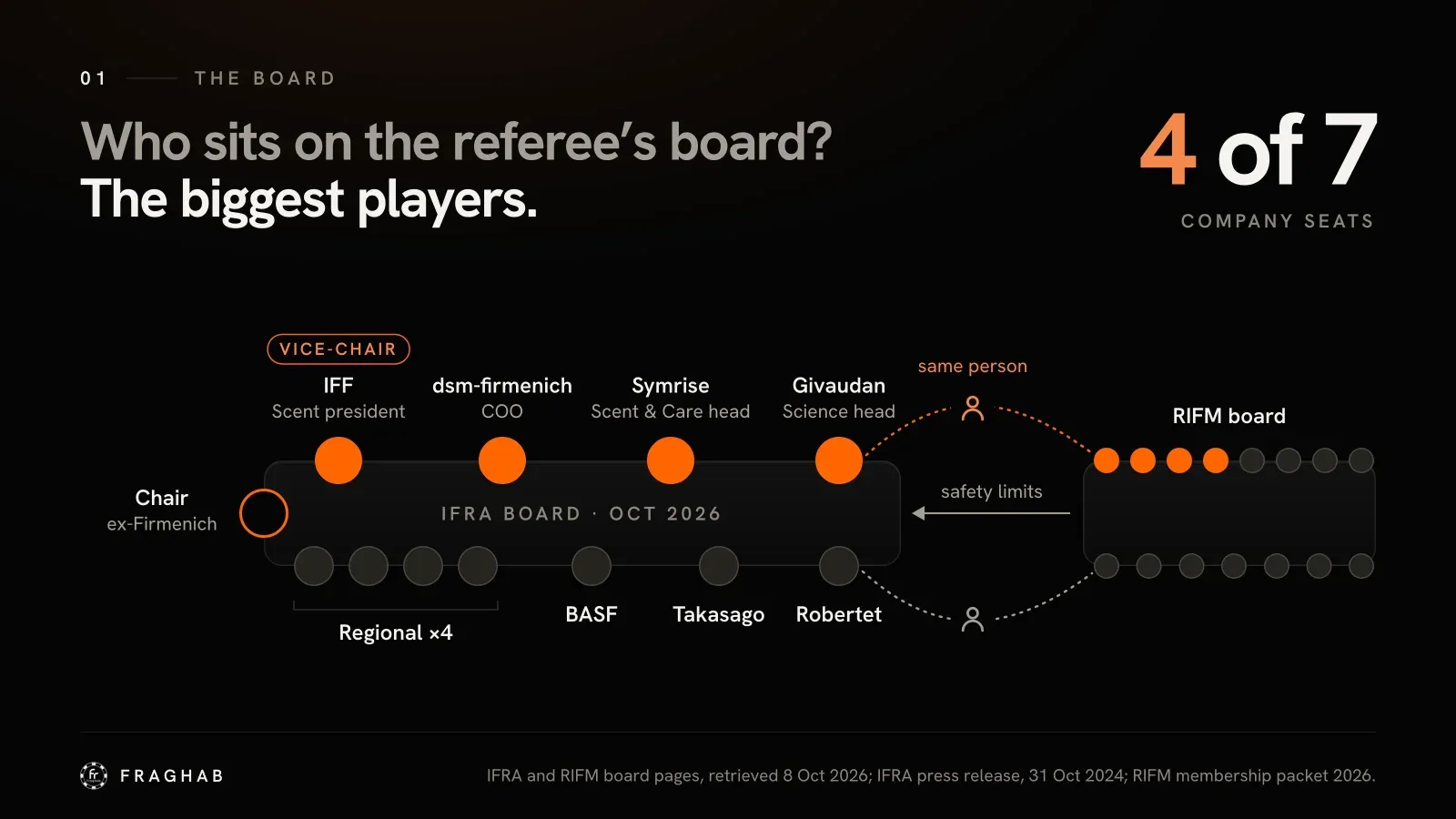
IFRA’s top tier of membership is seven companies: dsm-firmenich, Givaudan, IFF, Symrise, BASF, Robertet and Takasago. Each gets a seat on the board, alongside four regional representatives. Then look at who is sitting in those seats today. The chair, Paul Andersson, finished his career as president of Firmenich China. The vice-chair, Ana Paula Mendonça, is IFF’s President of Scent, the division that sells IFF’s perfume oils and fragrance ingredients. dsm-firmenich sends its chief operating officer, Symrise the president of its scent and care business, and Givaudan its head of fragrance science, Jeremy Compton.
The two people who chaired IFRA before Andersson came from Symrise and Givaudan. The Givaudan one, Michael Carlos, chaired IFRA while also sitting on Givaudan’s board as a non-executive director, and until 2018 he chaired the industry’s research institute as well.
Nobody here is a compliance clerk on loan. Three of them run, or help run, the businesses that sell the molecules.
That research institute is the Research Institute for Fragrance Materials, RIFM, a US trade association set up in 1966 after IFF’s chairman wrote to rival houses. RIFM tells prospective members, in plain words, that its safety conclusions include “the maximum acceptable concentration (MAC) values that become the IFRA Standards.” All four big houses sit on RIFM’s board too, each through a senior executive, and Givaudan is represented on both boards by Jeremy Compton, its global head of science and technology for fragrances.
RIFM’s membership pitch lists the perks. One of them is a “First look at developing IFRA Standards during the consultation phase.” A company that wants to join needs two existing members to sponsor its application, and two thirds of RIFM’s board to approve it.
The drafting happens inside the industry too. IFRA’s own guidance says the task force that turns RIFM’s numbers into Standards “consists of Industry regulatory and safety experts and the IFRA Secretariat.” The final safety call belongs to RIFM’s Expert Panel of academics, described as having “no ties to the fragrance industry.” RIFM’s procedures say those academics are paid $4,000 a meeting day, that RIFM’s president drafts their agenda, and that RIFM’s general counsel is their legal adviser. Their conflict-of-interest statement asks them to further RIFM’s mission and to “act responsibly for the benefit of the fragrance and flavor industry and consumers of its goods and services.”
In fairness, the panel’s members are named, its minutes are public and its assessments are peer reviewed. My question is who sets the table, not whether the people at it are honest.
Then there’s the clause that should bother everyone. IFRA members agree not to “instigate any action or seek any remedies against IFRA” over its Code of Practice or its Standards. They also agree not to tell regulators or campaigners anything that contradicts an IFRA position unless they make clear it isn’t IFRA’s view.
Imagine a wine club whose membership form makes you promise never to sue it over the tasting notes.
Who Pays for the Referee?
I couldn’t find IFRA’s accounts or its dues formula published anywhere. What its bylaws do say is how the money turns into power. The voting rights of its company members are “reflective of their share of the Association dues,” capped at two thirds of all votes, and the board sets each company’s dues every year.
Pay more, vote more.
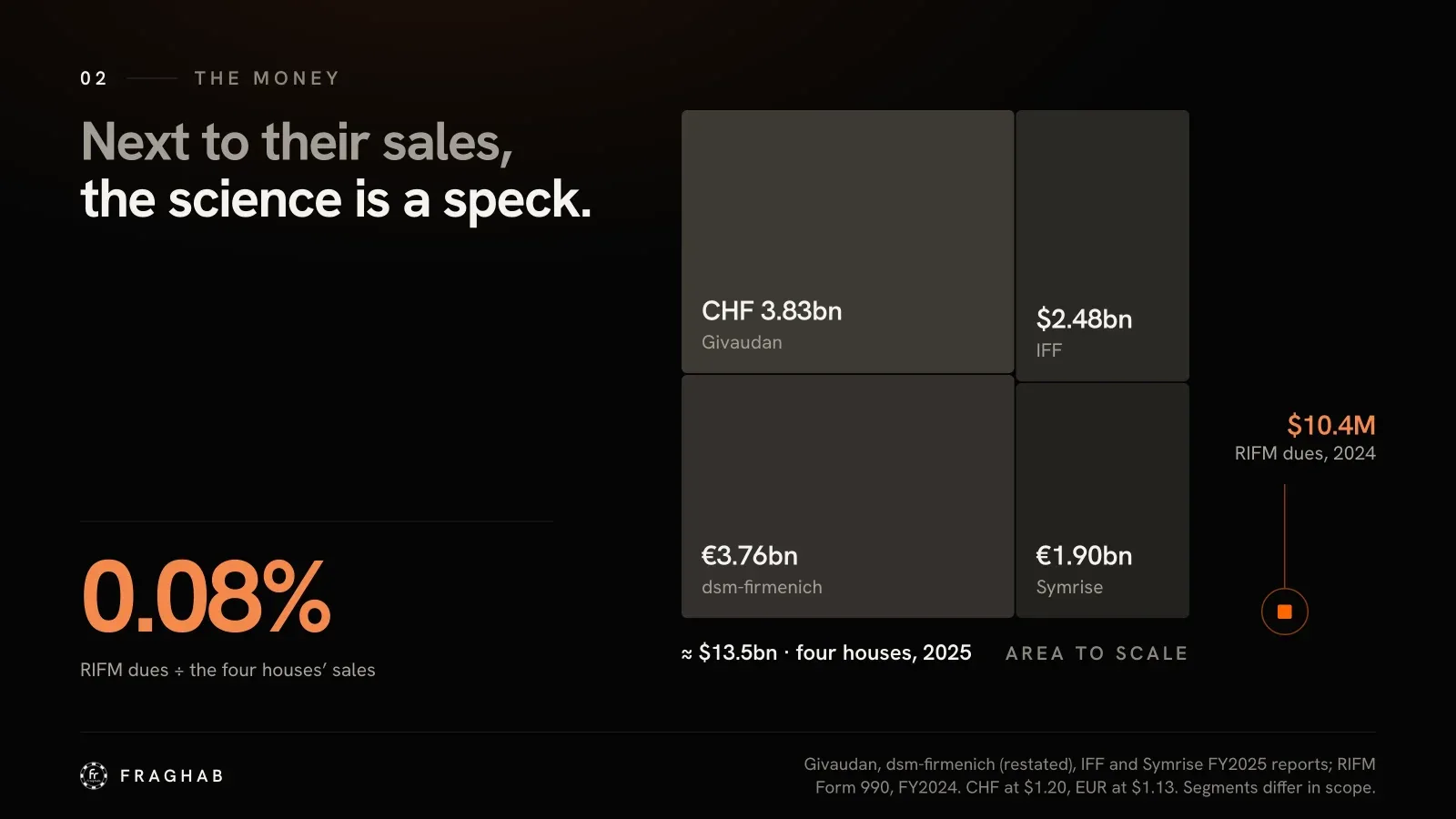
RIFM is easier to see, because it files a US tax return. In 2024 it took in $12.1 million, and $10.4 million of that, about 86%, was membership dues.
Now set that against what the four big houses sell. In 2025, Givaudan’s fragrance and beauty division sold CHF 3.83 billion. dsm-firmenich’s perfumery and beauty unit sold €3.76 billion. IFF’s scent segment sold about $2.48 billion, and Symrise’s scent and care segment €1.90 billion. At 2025 exchange rates, that is roughly $13.5 billion.
Every dollar of dues RIFM collected in 2024, from every member it has, comes to less than a tenth of one percent of that.
Is that a lot?
Not for them. Even if the four paid every cent of it themselves, the science behind the rules would be small change next to what rides on it.
Imagine golf’s rules on which balls are legal being written by an association where the four biggest ball makers held four of the seven company seats, the vice-chair and a seat each on the testing lab’s board, the chair had finished his career at one of them, and every member had signed away the right to sue over the result. Now imagine those four also held the patents on the replacement for whatever ball the rules took away.
You wouldn’t need to prove a conspiracy to find that uncomfortable.
What Does a Fragrance House Actually Sell?
In 2020 a Symrise perfumer told a trade magazine that reformulation is “a godsend for captive synthetics.” To see why, you need to know how the big houses sell smell. They barely sell it to you at all.
They sell it to brands, in two forms.
The first is the finished fragrance oil, the concentrate a brand dilutes, bottles and puts its name on. IFF’s annual report calls these “Fragrance Compounds,” which it describes as “unique and proprietary combinations of multiple fragrance ingredients.” The perfume you buy from a fashion house was usually composed by a perfumer at a fragrance house, with the brand as the client. By Symrise’s own annual reports, the four biggest houses hold between half and two thirds of the wider market for flavours, fragrances and aroma chemicals, depending on the year and how it’s counted. Nobody publishes a figure for fine fragrance alone.
The second is the raw material itself. All four make individual aroma molecules, and they sell many of them openly, including to the rivals they compete against for brand work. IFF says its fragrance ingredients are “used internally and sold to third parties, including competitors.” Symrise sells its aroma chemicals to “other companies in the fragrance and flavor industry.”
Some of those molecules are famous, at least among people like us. Hedione, the airy, luminous jasmine material, came out of Firmenich’s labs in the late 1950s and made its fine-fragrance debut in Edmond Roudnitska’s Eau Sauvage for Dior in 1966. Iso E Super, the velvety wood that people swear disappears and comes back, was synthesised at IFF in 1973. Escentric Molecules built a cult bottle, Molecule 01, out of nothing else. Galaxolide and Cashmeran are IFF’s too, Javanol and Ambrofix Givaudan’s, Habanolide and Ambrox Super Firmenich’s.
A captive is the other kind of molecule, the kind you can’t buy.
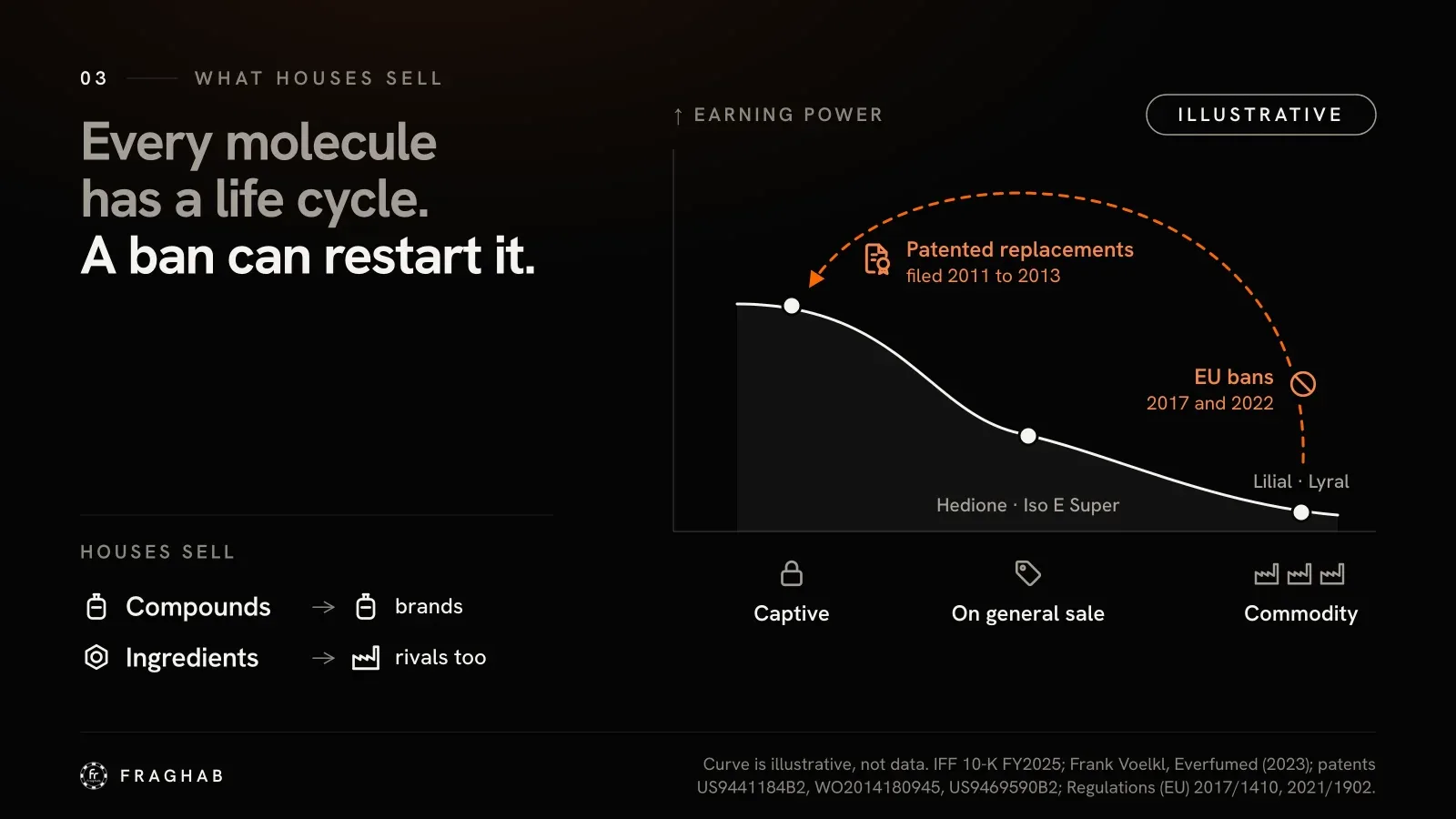
Frank Voelkl, a Firmenich perfumer, explained it to the fragrance site Everfumed in 2023: a molecule “is considered captive when a fragrance house such as Firmenich discovers a new fragrance ingredient,” and it is then “exclusively used in fragrances from Firmenich, created by Firmenich perfumers.” The house protects it with a patent “to avoid any other company copying or manufacturing that same ingredient.” A brand that wants a perfume built on that molecule has to hire that house to make it.
Captives don’t stay captive forever. “Eventually, captives will be released, for example, when the patent has expired,” Voelkl said. The molecule joins the catalogue and gets sold to everyone. Years later, once other chemical companies can make it too, it becomes a commodity, and as usually happens once anyone can make a chemical, its price falls.
So every molecule has a life cycle a finance department would recognise. You’d expect it to earn most while it’s exclusive, less once it’s on general sale, and least once it’s a commodity. That gives a big house every reason to want perfumers on its newest materials, and very little reason to mourn when an old, cheap material made by many suppliers disappears, especially if it has the patented replacement in a drawer.
And two of the big houses have told investors that regulation works in their favour. Symrise’s investor presentations in 2019 and 2022 listed “High barriers to entry e.g. core list system and increasing regulatory pressure.” Givaudan’s listed “regulations” among its own. A core list, in IFF’s words, is how big consumer-goods customers “limit the number of their suppliers.” Get on the list and you’re invited to bid. Stay off it and you aren’t.
By their own account, more regulation means fewer newcomers.
The smaller houses that do compete often buy raw materials from the big four. IFF’s own annual report says it sells ingredients to competitors. And market participants who answered the Commission’s questions told it that other manufacturers depend on the four for raw ingredients, and that a rival who undercut them on price might be threatened with losing its supply. That’s an unproven allegation. If it’s even roughly right, a mid-sized house that loses a commodity to a restriction may end up buying the replacement from a competitor, or finding it can’t buy it at all because it’s a captive.
Who Sells the Replacement When a Molecule Is Banned?
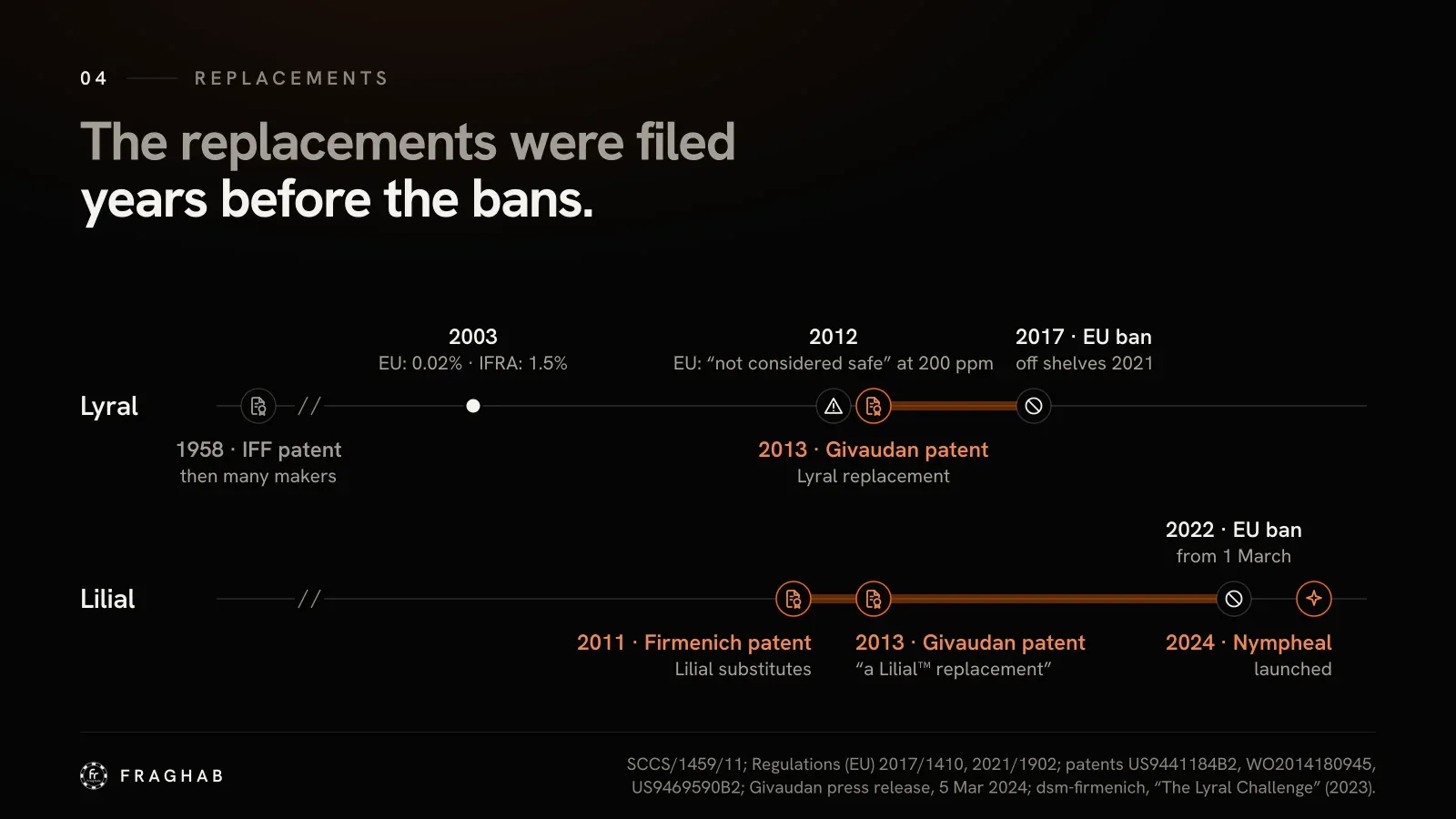
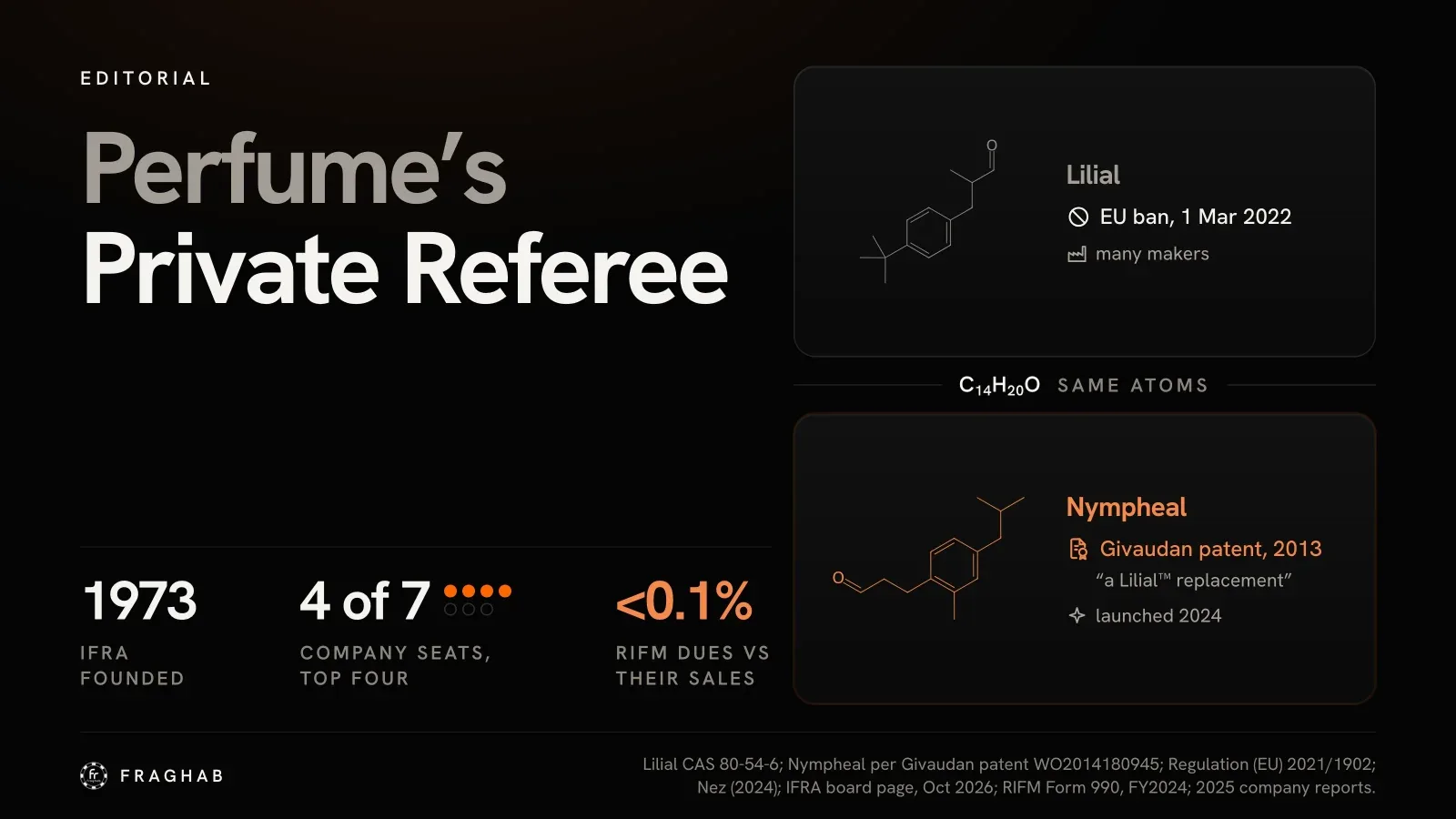
For decades, a great deal of the lily of the valley in modern perfume leaned on two aldehydes, Lilial and Lyral. Both were born at big houses. IFF patented Lyral in 1958, and Lilial was a Givaudan trade name. By the 2010s they were commodities, cheap and made by many suppliers. A dsm-firmenich chemist put Lyral’s world consumption at its peak at “over 1000 tons” a year.
That is the size of the hole a ban leaves.
Both molecules ran into trouble. In 2012 the EU’s Scientific Committee on Consumer Safety said Lyral “is not considered safe, even at concentrations as low as 200 ppm.” The EU banned it, along with atranol and chloroatranol, two of the most potent allergens in oakmoss, from new products in 2019 and from shelves in 2021. Lilial was classified as toxic to reproduction and banned from EU cosmetics on 1 March 2022.
The replacements were waiting. In 2011, Firmenich filed a patent noting that Lilial was “more and more limited in use due to increasing toxicological concerns” and that “there is a need for substitutes.” In 2013, Givaudan filed one for a molecule it called “a Lilial™ replacement” that “does not attract the regulatory concerns associated with Lilial™.” That molecule became Nympheal, which Givaudan launched in 2024 as providing “the broadest offering from a regulatory perspective.” Another Givaudan patent from 2013 describes a “replacement for cyclohexal,” one of Lyral’s trade names.
Givaudan’s Jeremy Compton explained the thinking in a 2024 interview: “Nympheal came out of a program looking for new white floral materials to replace some older ones that will no longer be used.” That’s an ordinary thing for a supplier to do, and I’m not suggesting he or anyone at Givaudan did anything improper. My point is about structure, not people: the companies that sit on the boards setting the limits are the same companies that sell the replacements when a limit bites.
A Symrise perfumer said what that means, on the record.
That was Suzy Le Helley, speaking to Premium Beauty News in 2020: “Reformulation is a godsend for captive synthetics because it offers an additional opportunity to use them.” She went on to say that companies’ strategies “were clearly oriented towards the substitution of Lyral and Lilial to offer perfumers a new replacement tool,” and that Symrise had developed a captive of its own.
That isn’t a leaked memo. It’s an interview in a trade magazine.
Lilial and Lyral are the life cycle running backwards. Two molecules at the cheap end of the curve were removed, and their replacements started again at the top, single-source and patented into the 2030s. When that happens, a little more of the perfumer’s palette is something rented from one landlord.
The Case for IFRA Is Stronger Than It Looks
So IFRA bans naturals to sell you lab juice?
No. And the honest version of this story has to say so.
In each of the three big reviews I found, the EU’s own scientists wanted IFRA’s methods stricter, not looser. In 2008 they said of the industry’s risk model, “There is no confidence that the levels of skin sensitizers identified by the dermal sensitization QRA are safe for the consumer.” The biggest bans, on Lyral, the oakmoss allergens and Lilial, came from EU law, not IFRA. IFRA even submitted safety dossiers defending Lilial, in 2013 and again in 2017, before the EU’s scientists concluded it “cannot be considered as safe.”
Natural materials aren’t singled out by IFRA, either. By my count, about 3% of natural extracts carry a Standard of their own, against nearly 9% of everything else on the list. The count misses limits that reach naturals through their constituents, but it doesn’t describe a body hunting them. When the EU revised how plant extracts are classified under its chemical-labelling law, IFRA and Cosmetics Europe welcomed the final deal as a way “to avoid the overclassification of a number of natural substances.”
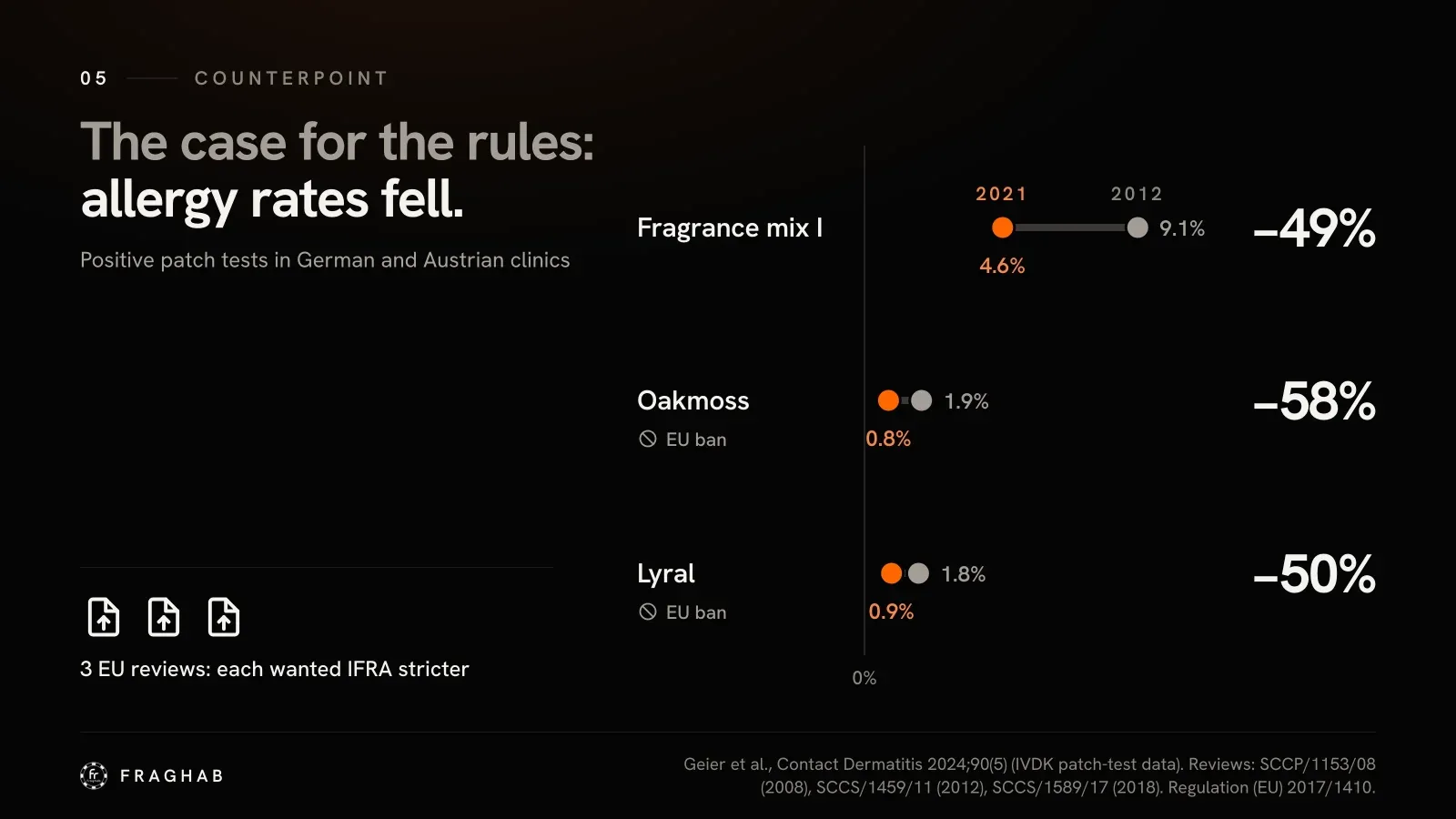
And the restrictions seem to work. A network of dermatology clinics in Germany and Austria tracked contact allergy between 2012 and 2021. Positive patch tests to the standard fragrance mix fell from 9.1% to 4.6%, and to oakmoss from 1.9% to 0.8%. The researchers credited the EU ban.
Fewer people are reacting. That counts.
The big houses’ own bestsellers don’t get a free pass. IFRA restricts Iso E Super, Cashmeran, Polysantol and a long list of other house molecules, and the EU’s expanded allergen-labelling list covers Iso E Super and Galaxolide alongside rose and jasmine. IFF warns its own investors that changes to EU chemical and cosmetics rules “may negatively impact certain products we offer, including enzymes and fragrance ingredients.” The big houses have also built their own natural supply chains, from Madagascan vanilla to Haitian vetiver.
Oakmoss is the best rebuttal to the cartoon version. When its allergens were limited, the fix wasn’t a captive. Suppliers produced oakmoss with the troublesome molecules removed, and the main synthetic stand-in is sold under different names by Givaudan, IFF and a smaller firm alike. Wasser, talking in 2014 about Mitsouko and its oakmoss, said Robertet “makes some oakmoss and tree moss without any of the nasty, naturally occurring molecules,” while conceding that “The new oakmoss evaporates very quickly, but old oakmoss was a fixative.”
A real loss for perfumers. No patent waiting at the end of it.
I’d rather say that plainly than build an argument on it. The real argument is better.
The Problem Is Who Holds the Pen
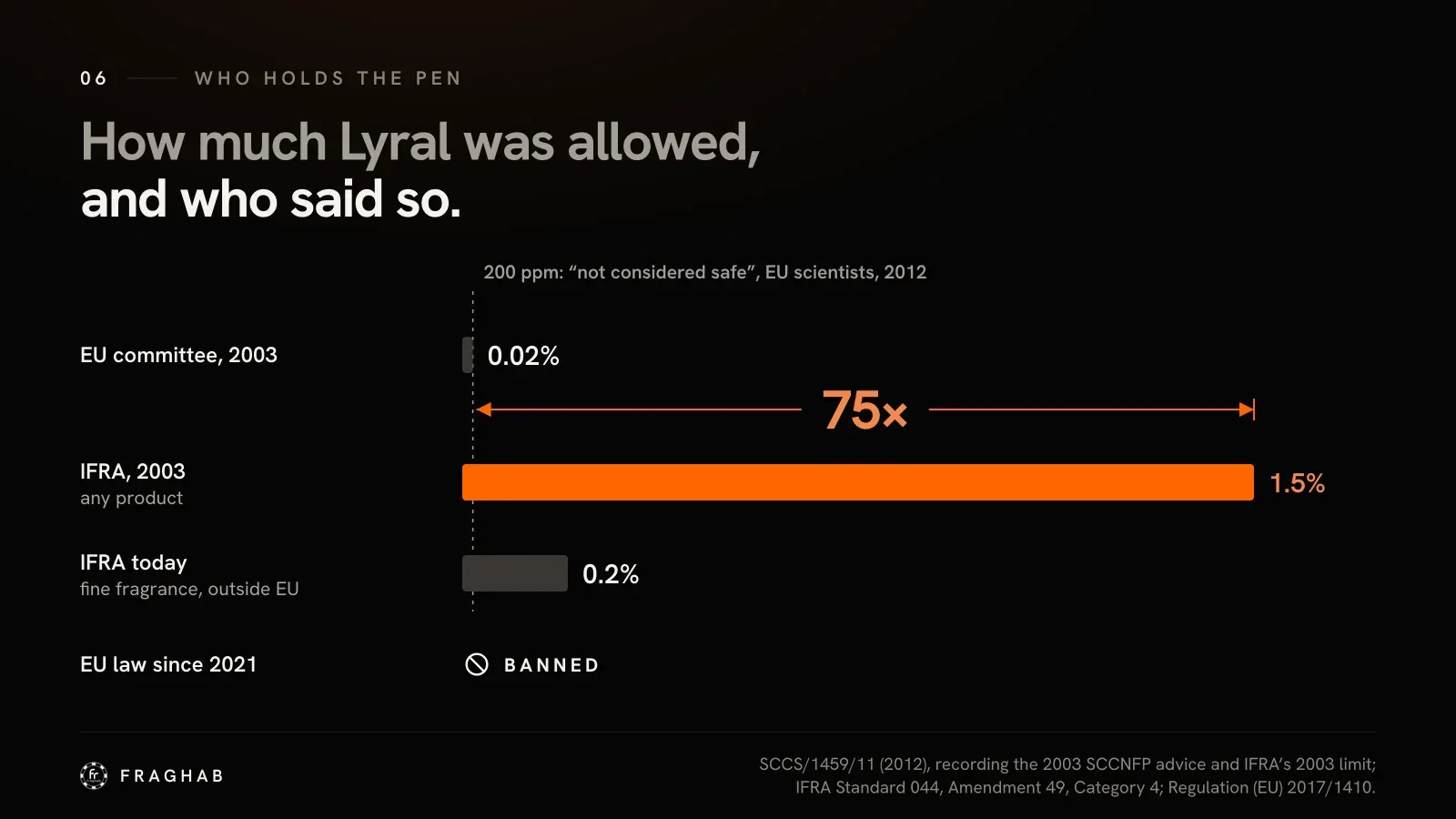
The problem is what the pen-holders earn while the real regulator makes up its mind.
Look at Lyral again. According to the EU’s scientists, it was used without any restriction until 2003. That year an EU committee recommended capping it at 0.02%, and IFRA set its own limit at 1.5%, 75 times higher. Brussels didn’t act on its own committee’s advice either, not until its 2017 ban, so the slowness wasn’t only IFRA’s. The industry’s stated reason was scientific: it set limits to stop people becoming allergic, not to protect people who already were. But by the time the ban arrived, Givaudan’s patented replacement had been on file for four years. And outside the EU, IFRA’s published Standard still allows Lyral at up to 0.2% in fine fragrance, ten times the 200 ppm the EU’s scientists said was not safe.
IFRA was behind the regulator’s scientists. Givaudan was ahead of both.
Two cases don’t make a law of nature, and I can’t show that anyone planned it this way. In my view the problem is how the system is built. A body whose board includes the biggest houses’ people has repeatedly been the more lenient party, the hard calls get made in Brussels, and the houses with research budgets can use the waiting years to patent what comes next. When a ban lands, every brand with an affected formula needs it reworked, and the house holding the replacement is well placed to do the work.
The cost of evidence works the same way. IFRA currently prohibits 22 materials, 19 of them synthetics, because there isn’t enough safety data to clear them. In its latest round of Standards, IFRA dropped a proposed limit on a macrocyclic musk after one respondent pointed to newer data showing it wasn’t a skin sensitiser after all. Requests to loosen limits on materials in lavender and cabreuva oils came with worries about reformulation rather than new data, and were turned down. That’s the system working as designed: data wins. Data also costs money.
A house with a research budget can defend a molecule it cares about. A small supplier of a niche material, or a cooperative distilling one oil, mostly can’t.
Then add what the Commission suspected. The General Court’s judgment records that third parties told investigators the four largest manufacturers “coordinate their votes in a concerted manner and successfully impose their views” within IFRA. It also summarises an intelligence report the Commission compiled from public sources, which said the four “colluded with IFRA to impose, inter alia, by adopting a Code of Practice, barriers to entry in the market for natural ingredients and fragrances to the benefit of synthetic ingredients.” Those are allegations from unnamed sources at the earliest stage of an investigation. Symrise called the search a fishing expedition, and says it has always maintained that it took part in no unlawful agreements with competitors. The court said only that the material was enough to justify a search, and decided nothing about whether any of it is true.
Some of this has already cost money. In 2024 the Commission fined IFF €15.9 million for obstructing the inspection: a senior employee had deleted WhatsApp messages exchanged with a competitor. IFF admitted it and helped the Commission recover them. The Commission didn’t name the employee. IFF has told investors it applied for leniency “in a number of jurisdictions,” and it has agreed to pay $43 million to settle US class actions over pricing. dsm-firmenich has agreed to pay $33 million. A settlement isn’t a finding of wrongdoing, the US cases are about pricing rather than IFRA’s Standards, and the fine was for the deleted messages, not for any cartel.
None of that proves the theory. All of it is on the record.
What Should Collectors Ask For?
Safety rules for perfume are worth having.
The EU’s scientists put fragrance allergy at 1 to 3% of the general population. Nobody serious wants a free-for-all.
What we should want is a referee nobody can accuse of playing for a team. That doesn’t require tearing anything down.
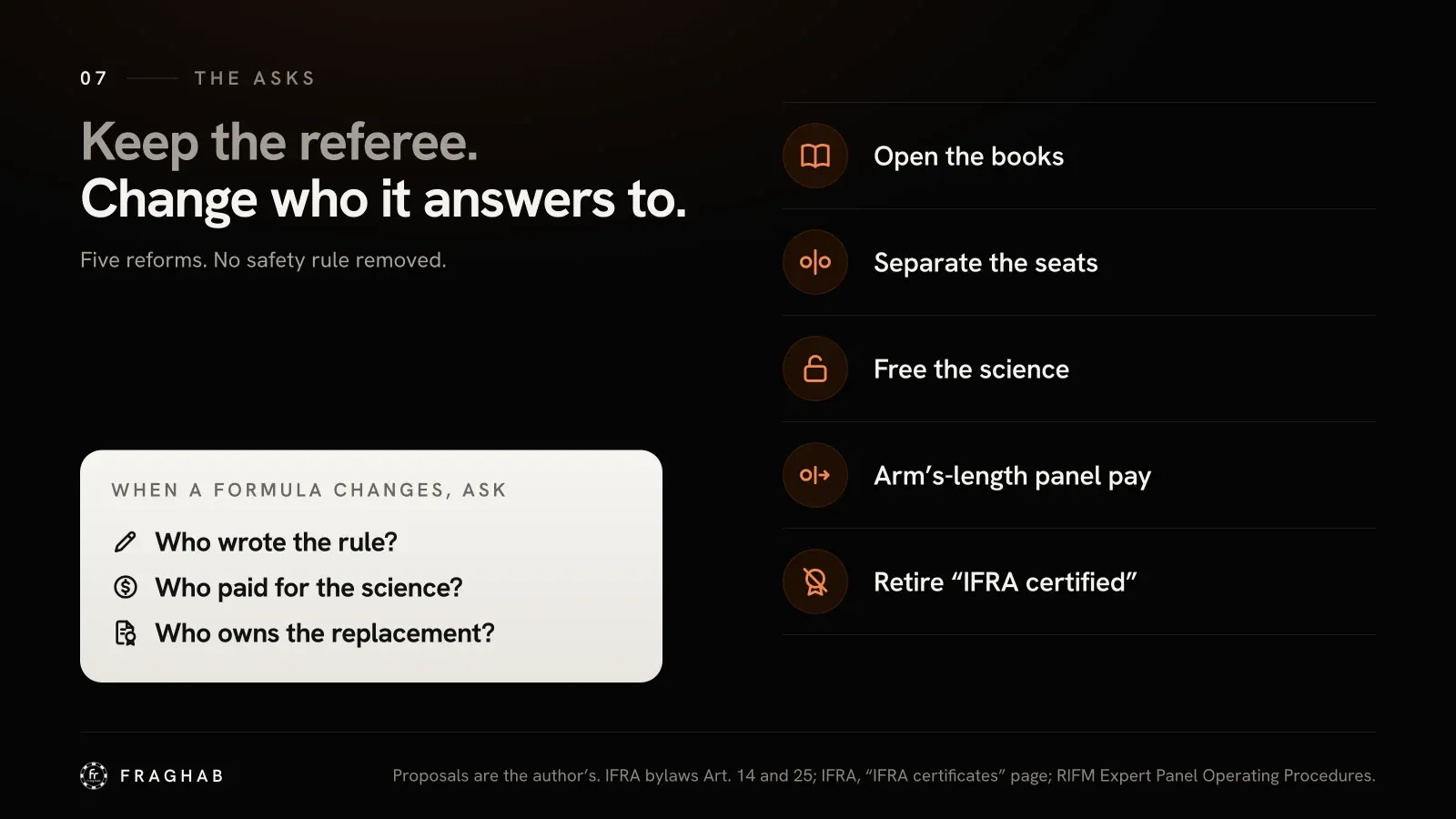
IFRA could publish its accounts, its dues formula and how its votes actually split. Executives who run fragrance divisions could step off the boards that steer the Standards. RIFM could make its full safety assessments, the “more robust” versions it keeps for members and paying subscribers, free to read along with the studies behind them. The Expert Panel could be paid through a channel the industry doesn’t control. And the industry could stop letting “IFRA certified” stand in for a safety seal that doesn’t exist, because IFRA itself says it “does not issue certificates, nor does it authorize any third-party organization to certify on its behalf.”
Collectors have more say than it seems. We’re the ones who notice when a formula thins out, post the side-by-sides, and keep vintage bottles as evidence. When the next reformulation lands, don’t stop at typing IFRA. Ask who wrote the rule, who paid for the science, and who owns the replacement.
Nobody’s asking for fewer referees.
Just one the biggest teams don’t help pay.
Sources, 43
- European Commission, IP/23/1532, inspections in the fragrance industry (7 Mar 2023) (opens in a new tab)ec.europa.eu
- Swiss Competition Commission (COMCO) release (8 Mar 2023) (opens in a new tab)newsd.admin.ch
- General Court, Case T-263/23, Symrise v Commission (30 Apr 2025), ¶4, ¶31, ¶54, ¶66–68, ¶71, ¶72, ¶76 (opens in a new tab)eur-lex.europa.eu
- General Court, Case T-263/23, Symrise v Commission (30 Apr 2025), ¶4, ¶31, ¶54, ¶66–68, ¶71, ¶72, ¶76 (opens in a new tab)ferenda.lagen.nu
- European Commission, IP/24/3435, IFF obstruction fine (24 Jun 2024), including IFF’s cooperation in recovering the deleted data (opens in a new tab)ec.europa.eu
- IFF Form 10-K FY2025 (Scent segment and 2025 sales, fragrance ingredients “sold to third parties, including competitors”, core lists, EU regulatory risk, leniency) and 10-Q Q2 2026 (settlements) (opens in a new tab)sec.gov
- IFF Form 10-K FY2025 (Scent segment and 2025 sales, fragrance ingredients “sold to third parties, including competitors”, core lists, EU regulatory risk, leniency) and 10-Q Q2 2026 (settlements) (opens in a new tab)sec.gov
- Symrise press release, US DOJ investigation closed (9 Feb 2026), including “always maintained that it did not participate in any unlawful agreements”; UK CMA case 51257 page (Symrise closed 19 May 2025; investigation of the others continuing); COMCO release dated 8 Mar 2023; dsm-firmenich $33m settl
- IFRA bylaws, Art. 2, 12, 14, 25 (ifrafragrance.org)
- IFRA Board page (retrieved 8 Oct 2026); IFRA press releases of 1 Apr 2020 (Gliewe) and 31 Oct 2024 (Andersson); Givaudan board profile of Michael Carlos (opens in a new tab)ifrafragrance.org
- RIFM Board of Directors (retrieved 8 Oct 2026) (opens in a new tab)rifm.org
- RIFM Form 990, FY2024 (EIN 22-1822067): membership dues $10,354,415 of $12,093,553 revenue
- RIFM Prospective Membership Packet 2026 (MAC values “that become the IFRA Standards”, “First look”, sponsorship and admission, database) (opens in a new tab)rifm.org
- RIFM Expert Panel Operating Procedures (amended 26 Sep 2024) and Conflict of Interest Statement (opens in a new tab)rifm.org
- IFRA, Guidance for the use of IFRA Standards, 51st Amendment, §2.3 (Risk Management Task Force)
- Premium Beauty News, IFRA restructuring (20 Apr 2010), “approximately USD 14 million per year”
- Givaudan full-year 2025 results (29 Jan 2026), Fragrance & Beauty sales CHF 3,830m (opens in a new tab)givaudan.com
- dsm-firmenich full-year 2025 report (12 Feb 2026), Perfumery & Beauty sales €3,760m (restated, continuing operations) (opens in a new tab)dsm-firmenich.com
- Symrise Group Management Report 2025 (Scent & Care sales €1,901m; Aroma Molecules; market shares); Symrise investor presentations, Nov 2019 and Sep 2022
- Givaudan General Investor Relations presentation, Jan 2022 (barriers to entry)
- Everfumed, “Frank Voelkl Interview: The World of Captive Molecules” (4 Apr 2023) (opens in a new tab)everfumed.com
- Nez, Samuel Douillet, on Eurofragance’s captives (6 Jan 2025) (opens in a new tab)mag.bynez.com
- Nez, J. Mignot, “The great history of IFRA” (25 Nov 2024)
- Hedione history: Chimia (2019) (opens in a new tab)chimia.ch
- Iso E Super and Molecule 01: Escentric Molecules, About (opens in a new tab)escentric.com
- Molecule owners (Galaxolide, Cashmeran, Javanol, Ambrofix, Habanolide, Ambrox Super, Polysantol): Fraterworks manufacturer listings, /givaudan /firmenich (opens in a new tab)fraterworks.com
- dsm-firmenich, J. Coulomb, “The Lyral Challenge”, Swiss Chemical Society Fall Meeting 2023 abstract OC-108 (opens in a new tab)fm23.scg.ch
- Patents: Firmenich US9441184B2 (priority 30 Sep 2011); Givaudan WO2014180945 (priority 8 May 2013); Givaudan US9469590B2 (priority 10 Jun 2013)
- Givaudan, Nympheal press release (5 Mar 2024) (opens in a new tab)givaudan.com
- Personal Care Insights, “Flower power: Givaudan on why Nympheal is a game-changing molecule” (14 May 2024) (opens in a new tab)personalcareinsights.com
- Premium Beauty News, interview with Suzy Le Helley of Symrise (9 Jun 2020) (opens in a new tab)premiumbeautynews.com
- SCCP/1153/08 (2008) (opens in a new tab)ec.europa.eu
- SCCS/1459/11 (2012) (opens in a new tab)ec.europa.eu
- SCCS/1591/17, opinion on Lilial (2019); Regulation (EU) 2021/1902; Regulation (EU) 2017/1410; Regulation (EU) 2023/1545
- IFRA Standard 044 (HICC) (opens in a new tab)ifrafragrance.org
- IFRA 51st Amendment consolidated Standards and Transparency List 2025 (natural vs single-material count)
- IFRA 52nd Amendment end-of-consultation letter (31 Aug 2026), §3.6 to §3.8; IFRA 51st Amendment prohibitions for insufficient data (22: 19 single materials, 3 natural extracts)
- SCCS/1459/11, HICC history: SCCNFP 0.02% recommendation (2003, “not been implemented”), IFRA 1.5% limit (2003), industry’s “induction rather than elicitation” reasoning
- Cosmetics Europe and IFRA, CLP agreement (6 Dec 2023) (opens in a new tab)mynewsdesk.com
- Geier et al., Contact Dermatitis 2024;90(5):470–478 (IVDK patch-test trends, 2012–2021)
- Persolaise, “A Clearer Vision: Guerlain’s Thierry Wasser at Selfridges” (5 Aug 2014) (opens in a new tab)persolaise.com
- IFRA, IFRA certificates (opens in a new tab)ifrafragrance.org
- The Good Scents Company, methyl atrarate trade names (Evernyl, Veramoss, Phenomoss); Givaudan 2017 investor presentation (sourcing in Madagascar and Haiti)
Filed under
Published under Fraghab’s editorial standards. alex keeps the copyright, and wrote every word of this — an editor here cannot change them. Something wrong? Tell us.