The Fragrance Collector’s Apology
Why do perfume collectors feel compelled to justify having a collection?
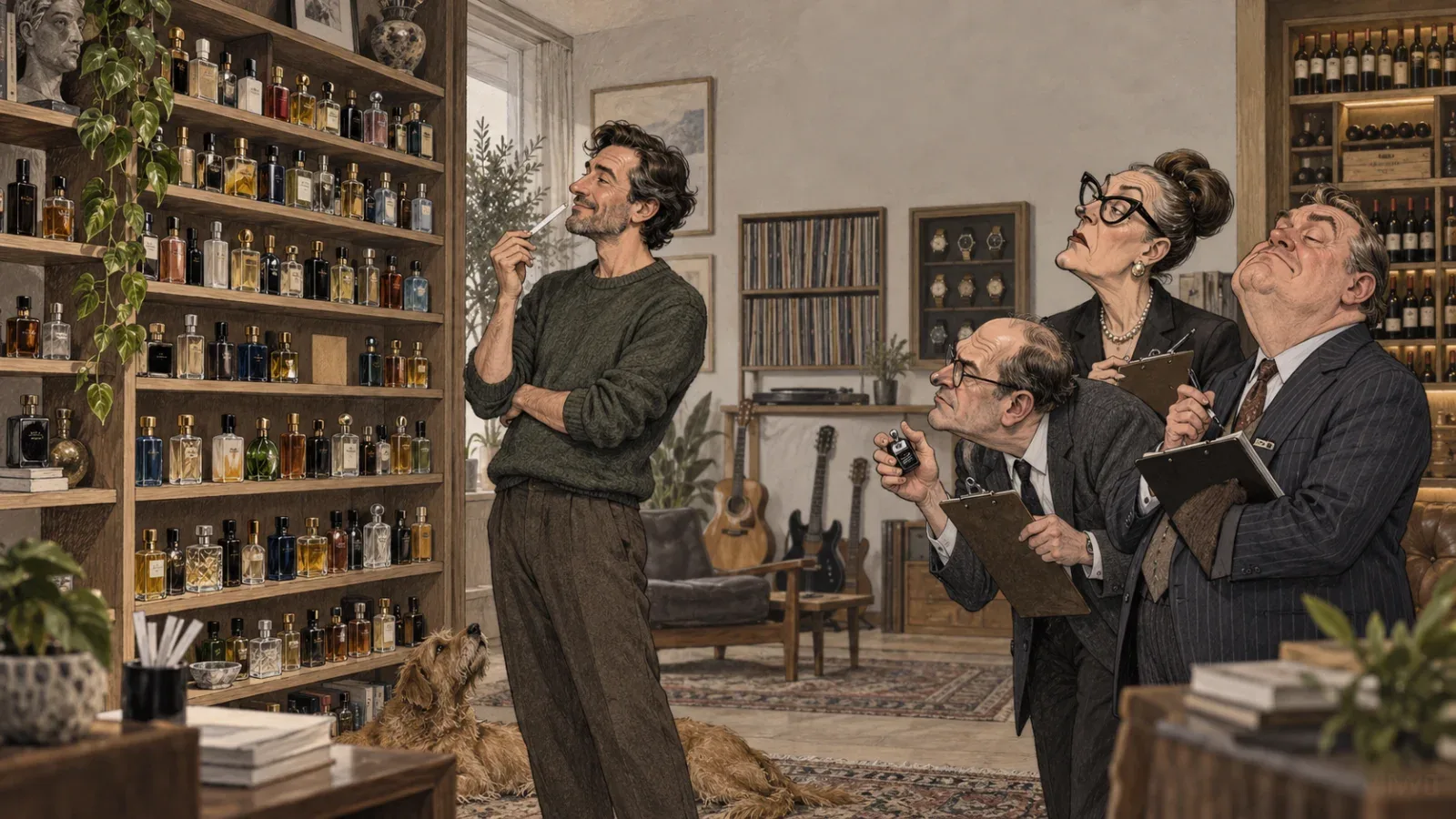
Spend enough time around fragrance collectors and you begin to notice a strange ritual. Someone posts a photograph of their collection, maybe forty bottles, maybe a hundred, and before anyone else has the chance to judge them, they start doing it themselves. They know it’s excessive. They “might have a problem.” Nobody should ask what they spent. Their wallet hates them. This is definitely the last bottle. The apologies are usually jokes, but jokes have a funny way of revealing what people actually believe, and fragrance collectors seem unusually convinced that the existence of their collections requires some kind of defense.
That would be less interesting if we applied the same standard everywhere else. A man with two thousand records has a serious music collection. Three hundred bottles of wine in a temperature-controlled basement is a cellar. A wall of bourbon that its owner has no realistic chance of drinking before he dies is admired as evidence of taste, patience, and probably a worrying amount of disposable income. Put eighty bottles of perfume on a shelf, though, and someone will inevitably point out that you can’t possibly use all of it.
They’re probably right. They’re also misunderstanding what they’re looking at.
Why Fragrance Collecting Feels Different
Fragrance has a peculiar legitimacy problem because perfume is still understood primarily through utility. For most people, it sits somewhere in the mental category of shampoo, deodorant, and toothpaste, a product you put on your body to accomplish a task. Perfume’s task is simply more luxurious. It makes you smell good. Viewed through that lens, a large fragrance collection does look ridiculous. Nobody needs eighty different solutions to the problem of smelling pleasant.
But collectors stopped solving that problem a long time ago.
Once fragrance becomes a serious interest, the object of the hobby changes. You begin collecting compositions, perfumers, houses, materials, styles, eras, and ideas. You discover that rose isn’t one smell but dozens of possible interpretations. It can be green, jammy, metallic, dusty, watery, candied, or almost leathery depending on who is using it and what surrounds it. Vanilla can smell like frosting in one composition, raw bean in another, and something dark, smoky, or almost suede-like somewhere else entirely. Oud can be medicinal, woody, earthy, animalic, polished, smoky, funky, or cleaned up so thoroughly that half the people wearing it would probably run screaming from the material it is meant to represent.
Eventually, you start recognizing a perfumer’s fingerprints. You notice recurring house styles. You smell something released thirty years ago and begin to understand what that period considered elegant, sexy, modern, or expensive. A material you barely noticed six months earlier becomes the thing you suddenly want to experience in every possible form. The bottle on the shelf stops being only a grooming product and becomes the physical record of that curiosity.
That is why “you’ll never finish all of those” has always struck me as such a strange criticism. It assumes depletion is the objective. Nobody asks the record collector whether he plans to wear out every album before buying another. Nobody looks at a watch collection and worries that its owner already has sufficient access to the time. A sneaker collector has only two feet. A car collector can usually drive only one car at a time. We understand instinctively that collections are not built around maximizing the practical utility of every object inside them.
Perfume somehow gets denied that same generosity because its medium is consumable.
What Are We Actually Collecting?
In some ways, that makes fragrance even more interesting to collect. Perfume is ephemeral by design. You spray it, experience it for a few hours, and it disappears. Its formula might be written down and its notes catalogued, but neither captures the actual experience. A note pyramid tells you about as much about a perfume as a list of instruments tells you about a song. The material matters, but so do proportion, texture, contrast, development, and the way the entire composition shifts over time.
Then memory gets involved, and all attempts to treat fragrance like a purely practical purchase become even more ridiculous. Anyone who has been wearing perfume long enough eventually encounters a bottle that no longer smells only like itself. It smells like the city where you first wore it. A hotel room. Someone you loved. Someone you wish you hadn’t. A winter when your life felt stuck. A summer when everything seemed to be moving in the right direction.
A fragrance can become an astonishingly efficient storage device for a period of your life, capable of retrieving something years later with a clarity that photographs sometimes can’t.
Try explaining that with cost per wear.
This is also why I think the comparison to wine, records, watches, books, or art is more than a convenient defense mechanism. Fragrance has authorship. It has movements, styles, schools of thought, techniques, cultural contexts, and material histories. Perfumers interpret the same raw materials differently. Houses develop recognizable aesthetic languages. Certain periods favor certain structures. Trends emerge, become dominant, get rejected, and eventually come back around with different names.
A serious collection becomes a kind of private archive of all of that.
Some bottles are there because the composition is exceptional. Some because the perfumer interests you. Some represent a category you wanted to understand better. Some are there because they remind you of a specific period in your life. Others are there for no more sophisticated reason than the fact that you smell them and think, Jesus Christ, this is good.
That is allowed too.
The idea that every bottle must justify itself through frequency of wear misunderstands collecting at a fundamental level. Sometimes possessing access to the experience is part of the value. You may wear something four times a year and still be very happy you own it. The bottle is not failing because you haven’t drained ten milliliters by December.
Collections are not efficiency projects.
When Collecting Becomes Something Else
This is the point where the fragrance collector usually wants me to keep going, tell everyone to mind their own business, and officially declare two hundred bottles a perfectly healthy amount of perfume.
Unfortunately, the people criticizing excessive fragrance consumption are not entirely wrong.
There is a version of this hobby that deserves scrutiny, and pretending otherwise would make the entire argument worthless. Modern fragrance culture has become extraordinarily efficient at turning interest into acquisition. There is always another release, another limited edition, another discontinued bottle supposedly disappearing forever, another sale ending at midnight, another reviewer telling you that the thing you hadn’t heard of yesterday is now absolutely essential.
Social media accelerates the entire cycle. Discovery, desire, validation, and purchase can now happen in a matter of hours. You see a bottle in the morning, watch five people describe it as a masterpiece by lunch, find a discount code in the afternoon, and have tracking information before bed. Two days later, something else has replaced it in the conversation.
For someone prone to compulsive buying, fragrance is an exceptionally accommodating hobby.
And there is a point at which collecting can quietly turn into something else. The excitement stops coming primarily from smelling perfume and starts coming from finding it, ordering it, and waiting for the package to arrive. The bottle lands on the shelf, gets sprayed a few times, and almost immediately the mind starts searching for the next target. The perfume becomes the receipt for an experience that was really about acquisition.
That deserves honesty.
If you’re carrying debt because of perfume, hiding purchases from your partner, buying bottles you do not particularly want because you physically cannot stop yourself from clicking “Add to Cart,” or constantly selling things you just bought at a loss so you can fund the next thing, that is not some charming eccentricity of being a collector.
That is a problem.
But this is where the conversation usually gets intellectually lazy. Instead of examining the behavior, we count bottles.
Twelve seems reasonable. Fifty gets suspicious. One hundred apparently qualifies strangers on the internet to become your financial advisor, therapist, and environmental ethics professor.
Bottle count is appealing because it gives us something easy to measure. It just tells us almost nothing.
Bottle Count Is the Wrong Question
Someone can own twelve fragrances and have a deeply unhealthy relationship with buying perfume. They can be carrying credit card debt, shopping compulsively every night, hiding packages, and using the arrival of something new to produce a brief emotional high that immediately needs to be replaced.
Someone else can own one hundred and eighty bottles accumulated over fifteen years, comfortably afford every one of them, understand their collection intimately, wear it regularly, and get enormous enjoyment from the hobby without sacrificing anything important to maintain it.
The person with more perfume is not necessarily the person with the problem.
That distinction seems obvious once you say it plainly, yet fragrance collectors themselves constantly undermine it. We describe purchases as relapses. We call ourselves addicts. We joke about needing interventions. We post photographs of bottles we are visibly delighted to own while explaining that someone should really take our credit cards away.
I’ve made those jokes too. They’re funny because there is some truth inside them.
But there is also something strange about a collecting culture that feels compelled to present enthusiasm as a failure of self-control.
Worse, focusing all of our anxiety on collection size lets the machinery encouraging overconsumption escape far too easily. It is much simpler to photograph someone’s 120 bottles and declare the whole thing insane than to ask why modern fragrance culture produces such relentless pressure to acquire in the first place. That would require uncomfortable conversations about haul culture, artificially scarce releases, influencer incentives, affiliate links, endless flankers, fear of missing out, and algorithms designed to make sure there is always another bottle waiting for your attention.
It would also require collectors to ask themselves questions more difficult than Do I own too many?
Do I actually want this fragrance, or do I want the feeling of buying something? Would I care about this bottle if nobody online were talking about it? Am I still exploring what I already own? Can I comfortably afford this without sacrificing something more important? Is my collection becoming more interesting, or simply larger?
Those are useful questions because their answers can actually change your behavior.
And sometimes the answer to all of them will still be yes. Yes, you can afford it. Yes, you genuinely love fragrance. Yes, you already own plenty. Yes, you would still like another bottle.
Fine.
Buy the fucking perfume.
Not because every purchase is automatically sensible, and certainly not because calling something a hobby exempts it from financial responsibility. Buy it because adults are allowed to spend some of their time and money on things whose value cannot be reduced to practical necessity.
That is essentially what hobbies are.
People spend thousands of dollars traveling to golf courses where they repeatedly hit a small white ball into trees. They restore cars that spend most of their lives inside garages. They collect first-edition books they have already read. They buy guitars wildly beyond their ability to play them. The inefficiency is not some unfortunate defect that disqualifies these pursuits from being meaningful. In many cases, it is almost inseparable from collecting itself.
Stop Apologizing for the Shelf
The meaningful distinction is not between owning enough and owning too much. It is between appreciation and compulsion.
A hundred fragrances you barely care about, bought with money you did not have while desperately searching for number 101, should probably concern you. A hundred fragrances you love, collected intentionally and comfortably over years, is just a fragrance collection.
Maybe you will empty ten of them. Maybe twenty. Some will eventually be sold. Some will survive every collection purge you attempt for the next three decades. A few may become so tangled up with particular people, places, and periods of your life that getting rid of them will feel almost unthinkable. Others will eventually make you wonder what the hell you were thinking when you bought them.
That is what an archive looks like when it has been assembled by an actual human being rather than a museum curator.
The fragrance community would be healthier if it became simultaneously less ashamed of collecting and more critical of consumption. Those ideas are not opposites. We should be able to acknowledge that compulsive buying is real, that this industry is extremely good at encouraging it, and that some collectors need to seriously reevaluate their relationship with acquisition.
We should also be able to look at a shelf full of perfume without automatically treating it as evidence of pathology.
If your collection is hurting your finances, your relationships, or your ability to control your own behavior, take that seriously. No bottle smells good enough to deserve that kind of power over you.
But if you can afford what you own, you genuinely engage with it, and your collection adds more to your life than it takes away, stop introducing your hobby like you got caught cheating on your spouse.
You’re a fragrance collector.
You bought perfume. Not smack.
alex on video
Filed under
Published under Fraghab’s editorial standards. alex keeps the copyright, and wrote every word of this — an editor here cannot change them. Something wrong? Tell us.